1. Introduction
Based on the assumption that the Lagrange density contains the description of an elementary object and that the commutators of the communication relations of quantum mechanics contain the quantum mechanical properties of the objects, a representation of the objects by correlations is obtained by means of a Fourier transform of these. The obtained correlations, [1] [2], are combined into a structure of elementary objects under the condition of Hamilton’s principle, [3]. The correlation structures of elementary objects are characterized by the communication relations of quantum mechanics, which is considered to be the source of action1. The correlation structures exist in two states, which differ by the correlation directions. The two correlation directions can be interpreted as spin directions; If one assumes that the μ = 0 commutator can adopt positive and negative values, depending on the direction of circulation of the currents and thus describes positive and negative action, then the correlation structures with the change of the correlation directions and the change of the sign of the μ = 0 commutator represent the two states of an oscillator. In this report, the basics of the description of elementary objects by correlation structures are discussed and their consequences for the interpretation of nature are analyzed, [4].
First, the correlation structures of scalar fields and of Maxwell fields are presented and in the following sections their properties, their interactions and their applications for the interpretation of physical effects are discussed. The use of the path through the formation of correlation structures leads to an altered interpretation of the nature of elementary objects.
2. Structural Elements for Describing Nature
As in quantum mechanics, physical information theory (PIT), distinguishes structural elements for the mass- and charge-bearing objects from the structures that convey information between them. An example is an electron in which a distinction must be made between the nucleus of the electron and its photon cloud. In following the nucleus of the elementary objects is first described by oscillators of the scalar fields and the photons, which mediate the interaction between the objects by oscillators of the Maxwell fields, [5]. In a further step, an oscillator system is developed for the scalar fields, which simulates the properties of matter and charge, and allows a generalization of the description of nature solely on the basis of a four-dimensional (vector potential) field and the action, under the conditions of the Hamiltonian principle, [6]. In the following, it will be shown that all elements of nature—the nucleons of objects and their information carriers—can be described by a uniform structure—the four-blocks. The four-blocks consist of unit cubes of the four dimensions of space-time.
In the theory of physical information developed so far, we have to make two fundamental simplifications: 1) only oscillators of the nuclei and of the photon cloud are investigated, while an object consists of a large number of oscillators, which together form a previously unknown structure characteristic of the object (e.g. electron), and 2) only the properties of the oscillators for electromagnetic interaction and of gravitation are examined. The two nuclear forces in the context of the PIT consist of unknown structures, but we assume that they can also be described in the frame of the methods of the PIT. In this report, the properties of elementary objects are discussed under the conditions of the Hamiltonian principle, i.e. the minimization of the action; a quantitative evaluation is still missing, it requires a computer simulation of the correlation structures.
2.1. Scalar Oscillators
First, the scalar oscillators are analyzed in their representation as correlation structures. From the scalar Lagrange density and from scalar communication relations, [3], for example, the following products are obtained:
and
; Negative subscripts describe creators, positive annihilators. This results after a Fourier transformation in the correlations:
and
; the arrows describe the correlations, factors of Fourier transformation are neglected. Because in the two expressions
is identical, it can be written as
. Applying this on all correlations obtained from the scalar Lagrange density and from scalar communication relations the following structures are obtained under conditions of the Hamilton principle:
(2.1)
state Z1
The relations represent the correlation structure of a scalar μ = 0 oscillator in its oscillation state Z1. The scalar oscillators are derived from the scalar Lagrange density and from the scalar commutators of the communication relations of quantum mechanics. Each scalar oscillator of a μ-coordinate consists of the contributions of two scalar Lagrange densities and of two to each other conjugate scalar commutators O and X. The two commutators O and X are four-dimensional with respect to the overall structure, [7] because the elementary objects have a coherent four-dimensional structure, so that their time dependence results from the linking of the four dimensions. In (2.1) the arrows describe the correlations, they are always directed from a creator to an annihilator. Each scalar oscillator consists of four closed structures. The fields are dimensionless by normalization the derivative field by the Compton or space frequencies.
If the structures are to be represented in a rest frame and under the conditions of the Hamilton’s principle, then they must be formed from closed orbits with different signs in such a way that same current circulating in the whole structures, is extinguished in the sum for all currents. The scalar fields thus lead to four self-contained orbits for each μ-coordinate. For each current with a sign and a direction of circulation, there must be another current with the same direction of circulation and an inverse current sign, and the same applies to the same sign and different orbits.
The structure (2.1) has four different orbits and they form correlations with different signs.2 Each of the four coordinates μ = 0, 1, 2, 3 is associated with such a structure (2.1). The scalar oscillator consists of four elements, which are characterized by orbits of the scalar fields and which are determined by the directions of the correlations (from the creator to the annihilator). The orbits and their signs are interpreted as currents; they related to currents of quantum mechanics, [8]. In the correlation structure (2.1) the positive correlations are described by double arrows, with negative signs by single arrows.
The correlation between a scalar field and its derivative is a component of a commutator. The structure (2.1) contains two to each other conjugate commutators, which we designate by O and X due to their position in the correlation structure. The correlations between the fields form the density of the object and the correlations between two derivatives of the fields form the products of the derivatives in the scalar Lagrange density. By means of the scalar fields, the oscillators can be formulated individually for each μ-coordinate, further down the interaction of the μ-structures between each other is examined.
The correlation structures of scalar fields of the form (2.1) can be described on space-time by commutators between canonical momenta, [3]. The canonical momenta generally arise in the form
(2.2)
For the structure (2.1) with two positive scalar commutators, the representation
is obtained. The second oscillation state of (2.1), which is formed by reversing all correlation directions and has a negative sign for the scalar μ = 0 commutators, gives the representation
.
The π-fields in this representation are dimensionless and the factors resulting from the Fourier transformation are neglected. Each momenta consists of a contribution of the photon cloud
and of the core
of the elementary object. The exchange of information between the scalar objects takes place through information carriers, in the electromagnetic interaction by the photons of the static Maxwell fields and in the mass by the gravitons. Within the framework of the scalar fields, we simulate the information carriers by pure information: by a change (a delta) of the four-dimensional communication relations.
With the help of this representation, one can simulate the interaction between two elementary scalar objects, by assuming that it occurs by exchanging a delta of action. The action exchanged in interaction is represented by a change in the four-dimensional commutators of the scalar communication relations, for example:
. In this interaction, the canonical momenta change, e.g., for μ = 0 according to:
. This shows that the interaction between the scalar correlation structures can be described by exchanging a delta of four-dimensional commutators of the communication relations, i.e., by action, and that the consequence of this interaction is a change in the canonical momenta. As a result of the interaction with the exchange of action, the rest frame of the object changes (change of energy, speed).
In order to be able to analyze the four-dimensional structure of particles and anti-particles, we define a positive sign of the action for the scalar longitudinal μ = 3 oscillator of a particle for both oscillation states Z1 and Z2 and a negative sign of the action for the anti-particle3. In an interaction scalar objects must exchange information from O- and X photons in a full interaction period. The oscillation state, in which information is exchanged between the photon cloud and the scalar oscillator, we call the exchange state and the oscillation state in which the information is processed in the scalar oscillator and in which the interaction occurs in the photon cloud we call the particle state. For a scalar particle, in an interaction with the photon cloud, there are two possible states by exchanging the information of O and X in the exchange state Z1, and for the particle state follows in both oscillation periods the same particle state Z2:
(2.3)
Exchange state Z1.1: exchange of the O-photon: absorbed O-photon
is exchanged with O
of the photon cloud, resulting in the formation of
Z1.1-LS&RS:
Exchange state Z1.2: exchange of the X-photon: absorbed X-photon
is exchanged with X
of the photon cloud, resulting in the formation of
Z1.2-LS&RS:
Particle state Z2: formation of Z2-LS&RS:
.
An interaction between two scalar particles with the exchange of information
leads to a change in canonical momenta of a particle:
The method of forming correlation structures from the Lagrange density and the commutators of the four-dimensional communication relations thus allows the description of the interaction between them by characterizing the structures by action in the form of communication relations and by describing their interaction by changes in the communication relations. We interpret the changes in the communication relations as the change in action. It is the information that is exchanged in an interaction between two scalar objects. Scalar objects represent the oscillators of mass and charges and are thus characterized by action, they interact with each other by exchanging action and their properties change by the amount of the exchanged action, which is visible by changing the canonical momenta in space-time, [3]. Action is the physical property that characterizes elementary objects, deltas of action during interaction are exchanged between elementary objects as information, and the change in action modifies the objects after interaction. This is expressed in particular by the fact that after an interaction, the oscillators can again be represented by the commutators between the canonical momenta.
In addition, by characterizing particles and anti-particles by a positive and negative sign of the action, the description of the sign of a charge was replaced by the sign of the action in the μ = 3 oscillator. The justification of this approach arises from the formation of the correlation structures of the photons of the static Maxwell fields, in which the sign of the action in the longitudinal oscillators determines the sign of the electric and magnetic fields, [5]. In this way, the sign of charge of the elemental objects is traced back to the sign of action.
The starting points for the formation of the correlation structure of oscillators are two Lagrange densities and two commutators of the communication relations. When considering space-time, the oscillator properties in the Lagrange densities lack action. In our concept for the formation of scalar oscillators, we introduce on the correlation space the communication relations of quantum mechanics to the Lagrange density and obtain oscillators, which in space-time are described by commutators between the canonical momenta. These commutators therefore describe one-dimensional scalar oscillators on space-time.
2.2. Correlation Structures of Photons of Static Maxwell Fields
While the structure of the scalar fields is obtained from the Lagrange density, the photons of the static Maxwell fields are the carriers of the information contained in the structures of the elementary objects and exchanged between them. As can be seen from the considerations on the scalar fields, the change in action is obtained as information and, as it is well known, this change is carried by the photons of static Maxwell fields. Therefore, in order to obtain the structure of the photons of static Maxwell fields, we must consider the change in the Lagrange density of these fields. This is described by the energy-momentum tensor, [5], in particular by its trace. Using the double of the trace of the energy-momentum tensor of the Maxwell fields (in Lorentz gauge),
192 products are obtained between the changes in the vector potential:
(2.5)
(96 products)
(96 products)
From which, for example for the combination of subscripts 0, i, according to Fourier transform, correlation strings
(2.5a)
can be formed. If the correlation strings obtained from (2.5) are arranged according to their affiliation to the unit quantities, according to the electric fields Ei and according to the magnetic fields Bi and linked them to each other under conditions of the Hamilton principle, then the trace form 16 cubes, Figure 1: four unit cubes
, μ = 0, 1, 2, 3 and two Ei and two Bi-cubes, i = 1, 2, 3. In analogy to the procedure for scalar fields, the 16 cubes are linked to each other by correlations that correspond to the basic principle of the commutators of the communication rules of quantum mechanics. The resulting structures formed under conditions of the Hamilton principle are illustrated by an example of an O-photon of static Maxwell fields of a particle (positive μ = 3 oscillators) in
(2.6)
(2.6a)
(2.6b)
The correlation structures consist of two parts (1/2) and (0/3), which must be put on top of each other; the static Maxwell fields consist of O-X structures, the X-photons emerge from the O-photons by reversing all correlation directions. The second state Z2 of an O-X photon is obtained by reversing all correlation directions in O-X and changing the sign of the μ = 0 oscillators from positive in state Z1 to negative in state Z2. In the structure (2.6) the correlations are described by arrows from the creator to the annihilator; the double arrows describe the correlations of the commutators of the communication relations, which are directly connected to the unit cubes, and the single arrows the spin correlations. Each O-X structure is formed by the 16 cubes obtained from the trace of the energy-momentum tensor and by 10 sets of the components of the vector potential
, five positive and five negative. The positive components of the vector potential are indicated in (2.6) by bold letters, the others are negative. Two sets
, one positive and one negative are common to the two photons O and X and link them together. The correlation structure of photons of static Maxwell fields link the four dimensions between each other and in this structure the four dimensions are equally constructed, similar as in the scalar oscillators.
The photons of static Maxwell fields can be formed in different versions. There are always two different types of correlation structures for each physical property, which form two different oscillation states Z1 and Z2. The photons of static Maxwell fields for positive and negative charges are characterized by the μ = 3 oscillator. We write it for a particle with particle properties in the abbreviation OZ1(+)&XZ1(+) for the state Z1 and OZ2(+)&XZ2(+) for the state Z2, where the sign in the parenthesis characterizes the sign of the μ = 3 oscillator (the sign of the action in μ = 3 unit cube). The same applies to the anti-particle with particle properties: OZ1(−)&XZ1(−) for the state Z1 and OZ2(−)&XZ2(−) for the state Z2. Detailed analyzes give the structures W1α = OZ1(+)&XZ1(−), W2α = OZ2(+)&XZ2(−), and W1β = OZ1(−)&XZ1(+), W2β = OZ2(−)&XZ2(+) for photons of static Maxwell fields with wave properties. For the magnetic photons, the following structures are obtained: M1 = OZ1(+)&XZ2(−), M2 = OZ2(−)&XZ1(+), E1 = OZ1(−)&XZ2(+), E2 = OZ2(+)&XZ1(−). These variants of the correlation structures are assigned to their physical properties and consist of four-blocks, which will be discussed below.
The photons of static Maxwell fields, which have different properties, all consist of the same number of 16 cubes and 10 sets
of the vector potential. The cubes have the same structure in all properties, which is characteristic of the unit oscillators
and for the Ei and Bi fields, Figure 1, and always occupy the same positions in the correlation structure as in the relations (2.6)4. Photons obtain the different properties from different currents activated by the unit oscillators5. In the following, it is shown that the correlation structures of the photons of the static Maxwell fields formed in this way, describe the interaction between the oscillators of the charges and thus the electrical, magnetic and electromagnetic properties of the objects.
2.3. The μ = 0 Oscillator: The Source of the Action
In order to better classify the following remarks, the properties of the μ = 0 oscillator as a part of a four dimensional coherent structure, Figure 1, will first be discussed at this point. To do this, we consider two components of the vector potential
and
, both of which have the same magnitude but different signs. On the correlation space, these should consist of two amounts
and
, i.e. they each consist of a creator
and an annihilator
of the information of the components
. Under the condition of the Hamiltonian principle, the superposition of the two vector components
and
in space-time then leads to the deletion of the information. Not so on the correlation space; here, due to the independent of the two components and under Hamiltonian principle, they form a latent state in which the position of the sign between them is indeterminate. We describe this state by depicting the μ = 0 oscillator in Figure 1.
![]()
Figure 1. Formation of action: Elementary μ = 0 oscillators are generators of action, (A) for a graviton in state Z1; (B) for an O-X-photon of negative charge in state Z2; (C) for photons of light O and X in state Z1; (D) μ = 0 oscillator of basic structure in state Ω2; (E) and (F) the two E1-cubes of an O-photon of light in state Z1. Continuous lines for positive, discontinuous lines for negative currents.
On space-time, where the superposition can occur in space and time, we can describe the latent state on the correlation space by an oscillation and interpret the μ = 0 oscillator as follows: The creators
and
of the two components
and
generate simultaneously a current under the conditions of the Hamiltonian principle, which, when interacting, the signs between the two components
and
exchanges. This must be done in such a way that the resulting current is zero at all times. This is possible if the changes to the vector components
and
are also equal to the magnitude, but with the opposite sign, or opposite direction for two of them at the same time. Since the components
and
are independent of each other, the changes must also be independent, which is realized in Figure 1 by the fact that they are in the cube perpendicular to each other.
Figure 1 describes the shortest path of the currents for a change of signs between the components
and
. Since the course of the current is symmetrical, i.e., runs simultaneously from the positive and negative creator to the negative and positive annihilator, the current will continue the sign change after half an oscillation period and invert the creators to annihilators and the annihilators to creators, causing an oscillation of the sign between both components
and
.
While
and
on space-time are annihilated when the two components
and
are superimposed, there is a latent state of sign between the two components on the correlation space, where there is no time and no space. The interpretation of the oscillation in the correlation structure by the formation of currents between the creator and the annihilator is a tool that can be used to analyze the properties and interaction between the elementary objects. On the correlation space there is no time and no space, where the oscillations in space-time correspond to a flip mechanism.
Returning from the correlation space to space-time, the horizontal external correlations in Figure 1 form the commutators of the communication relations of quantum mechanics6, while the vertical correlations in Figure 1 on space-time form the products
of the derivatives of the fields in the Lagrange density and in the equations of motion. We conclude that the currents on the correlation space are the source of the action as a result of the change of sign between the components of the vector potential. In quantum mechanics, the latent state is described by the delta function
and its affiliation to the correlation space by the imaginary factor.
The elementary objects in a rest frame always contain two conjugate four-di- mensional commutators O and X. Each of the two commutators is formed by two currents from a positive and a negative creator to a negative and a positive annihilator. In the rest frame, the magnitudes of the currents in O and X are the same; they overlap in the vertical correlations with different signs and cancel at this point each other out. Depending on the sign and direction of circulation, the action resulting from the currents have different properties. The two currents with different signs are formed in the photons by the two parts (1/2) and (0/3) of the correlation structure (2.6). If the signs of the currents are placed in the first position of a bracket and the signs of the direction of circulation (negative clockwise) in the second position in the brackets, then the properties of the action generated by the structures like shown in Figure 1 can be characterized by the following statements: positive action for (1/2)/(0/3) = (+−)/(−+) and (−+)/(+−), negative action for (−−)/(++) and (++)/(−−) and all other sign combinations (+−)/(−−), (−+)/(++), (−−)/(+−) and (++)/(−+) give zero action. The latter four describe the properties of the deactivated Maxwell vacuum.
2.4. Photons of Light
For the photons of light, a structure deviating from the structure of the photons of the static Maxwell fields is obtained, [10]. This will be explained with an example. The following relations
(2.7)
(2.7a)
(2.7b)
X-photon: State Z1, μ = 0 (−+)/(+−), μ = 0 (++)/(−−)
μ = 1: (−+)/(++), μ = 2: (−+)/(++)
E1: (−+)/(++), E2: (−−)/(++), B1: (−+)/(+−), B2: (−+)/(++)
shows the correlation structure of an X-photon of light in the oscillation state Z1 linearly polarized in E2/B1, with wave properties. The photons of light are also produced by superposition of the two parts (0/3) and (1/2) and contain a four- dimensional commutator of the communication relations. All light photons consist of 12 cubes (the cubes E3 and B3 are missing) and four sets
, two positive and two negative of the components of the vector potential. In the photons of light, only the longitudinal oscillators are activated7: in the state Z1, μ = 0 is positive and μ = 3 negative, in the Z2 state, the signs of action in the longitudinal oscillators are reversed. The transverse oscillators μ = 1 and μ = 2 are disabled by having equal circulations of the currents with different signs, which corresponds to the structure of the vacuum; the action in transverse oscillators is zero.
The X-photon shown in (2.7) is linearly polarized in E2/B1, because in the two orbits gl and bo the currents are different from zero, while the superimposing currents in the orbits gr and bu cancel each other out. Accordingly, in E1/B2 linearly polarized photons are obtained; in elliptically polarized photons, all four orbits are activated by currents different of zero. The photon (2.7) has wave properties as a result of the activation of the currents in the orbits gl and bo, the sign of which is reversed with the change of state, so that when both states are superimposed, all currents in the structure are extinguished. Particle properties are obtained from the structure (2.7) by inverting the signs in the two transverse components of the vector potential (see Section 4.1). The correlation structures of the photons of light therefore describe the basic properties of light, other properties are contained in [10] and are also investigated below (Section 3.5 and 4.3).
2.5. Photons of the Maxwell Vacuum
The Maxwell vacuum consists of a static and a dynamic vacuum-part; the dynamic vacuum has the structure of the photons of light, [12]. The Maxwell vacuum is formed by deactivated virtual action, i.e., the two currents with different signs in the four unit-cubes have the same direction of circulation and cancel each other out. The following relations
(2.8)
State V1β = OZ1(−)&XZ1(+)
OZ1(−): μ = 0 (−−)/(+−), μ = 3 (−−)/(+−), μ = 1, 2: (−+)/(++)
XZ1(+): μ = 0 (++)/(−+), μ = 3 (++)/(−+), μ = 1, 2: (+−)/(−−)
show the correlation structure of the static state V1β = OZ1(−)&XZ1(+) of the Maxwell vacuum. The structures (2.8) are abbreviated; In order to save space, only the central areas are shown, but they can be supplemented according to the generally accepted pattern (see (2.6)). A state of the correlation structure of the static photons of the vacuum is obtained when the two parts (1/2) and (0/3) for O and X are superimposed and the O-X photon is formed by superposition of O and X.
Figure 2. Formation of networks in vacuum by photons of static Maxwell fields of the vacuum. From the Ei- and Bi-cubes of the photons of the vacuum (and other Maxwell photons), currents transverse into the neighboring correlation structures of the vacuum (reinforced arrows), thus forming a network.
A characteristic feature of the deactivated Maxwell vacuum is that the forming currents of the action are extinguished in all unit cubes. Also, for the vacuum of static Maxwell fields, there are two photons that oscillate in two states: V1α, V2α, V1β and V2β. The deactivated Maxwell vacuum is the carrier of the elementary objects and mediator of the information between them. In addition to the photons of static fields of the vacuum, the photons of the dynamic Maxwell fields can also be formed, which have a structure similar to that of the photons of light (2.7). Their four commutators form a deactivated virtual action, because the currents that form the action have different signs and the same orbits. In the Ei and Bi cubes of the vacuum the currents are deleted by a superposition of positive and negative currents.
The single photons of deactivated vacuum are linked between each other by peripheral currents. This is shown in Figure 2 at the example of the B3- and E3-cube of a photon of deactivated static vacuum: there are two currents which connect inside of the static photon with the outside of the correlation structure of the photon, linking with neighbor photons. The vacuum photons of static Maxwell fields form a network.
2.6. Gravitons
The Lagrange density, together with the commutators of the communication relations, describe the elementary objects and the changes in the Lagrange density are described in the context of the PIT by the photons, on the correlation space by the correlations of the energy-momentum tensor. In Section 2.2 we started from the scalar fields and described the interaction by exchanging the action in the form of four-dimensional commutators. Thus, the action describes not only the charges, but also the masses in their interaction. Since the masses cannot be described by real action, such as the charges, we assume that the gravitons can be described as mediators of information by virtual activate action. The virtual activate action is formed by two oscillators O and X with the same amount but different sign of action. A structure with these properties is obtained, e.g., by reversing the direction of circulation and the signs in one of the two parts (1/2) and (0/3) in the unit cubes in the deactivated virtual vacuum. The correlation structure (2.8) of the deactivated Maxwell vacuum thus becomes the structure of a graviton. This is represented by the following relations:
(2.9)
State G1α = OZ1(+)&XZ1(−)
OZ1(+): μ = 0 (−+)/(+−), μ = 3 (−+)/(+−), μ = 1: (−+)/(+−), μ = 2: (−+)/(+−)
XZ1(−): μ = 0 (++)/(−−), μ = 3 (++)/(−−), μ = 1: (++)/(−−), μ = 2: (++)/(−−)
Each O-X graviton then receives two four-dimensional μ-commutators each O and X with opposite signs of action. In such structures, in interactions, under the conditions of Hamilton’s principle, the action is exchanged between gravitons until the action with different signs in O and X is equal in magnitude. Therefore, there are also two modifications of gravitons that oscillate in two states: G1α = OZ1(+)&XZ1(−), G2α = OZ2(+)&XZ2(−), G1β = OZ1(−)&XZ1(+), G2β = OZ2(−)&XZ2(+). The virtual action contained in the gravitons can be activated, because the interaction with masses and with photons of the charges separates the positive and negative parts of action in the gravitons, Section 3.7, [4].
Since the Maxwell vacuum and the gravitons have the same structure, the Maxwell vacuum consists of a superposition of the deactivated vacuum with the gravitons. From everything we know today about the deactivated Maxwell vacuum, the latent (deactivated) action contained in the structures is likely to be small, so that the deactivated Maxwell vacuum is mainly determined by the content of action in the gravitons. However, the deactivated Maxwell vacuum superimposes all structures of the elementary objects and is thus the carrier of these objects and the mediator of the information (the virtual action, the four-blocks, see below).
2.7. Magnetic Photons
The magnetic photons are obtained from the electric photons by inverting the signs of the transverse oscillators compared to the μ = 3 signs. The photons obtained in this way are activated in one of the two oscillators in the transverse oscillators in both states, but only in one of the two photon variants in the longitudinal oscillators. New magnetic photons are formed as follows, [3]: By means of the states activated in both longitudinal and transverse oscillators, the states M1 = OZ1(+)&XZ2(−) and M2 = OZ2(−)&XZ1(+) are formed and from the states that are only longitudinally activated, the states E1 = OZ1(−)&XZ2(+) and E2 = OZ2(+)&XZ1(−) are obtained. As an example of a magnetic photon, in the relations. (2.10) M1 = OZ1(+)&XZ2(−):
O: μ = 0: (−+)/(+−), μ = 3: (−+)/(+−), μ = 1: (++)/(−−), μ = 2: (++)/(−−)
X: μ = 0: (++)/(−−), μ = 3: (++)/(−−), μ = 1: (−+)/(+−), μ = 2: (−+)/(+−)
the state M1 is reflected. Again, only the central regions of the photon are reproduced, which must be supplemented according to the pattern (2.6). A characteristic feature of magnetic photons is that in each state all correlations assigned to each other are parallel and equally directed. In the rest frame, therefore, all currents cancel each other out in both states. The formation of the magnetic photons by a current in a solenoid is analyzed in Section 4.5.
2.8. Formation of Four-Blocks of Action
The photons O and X are each formed by superposition of the two parts (1/2) and (0/3) (cf. (2.6)) and the static O-X photons by superposition of the photons O and X (example 2.10). If one analyzes the currents of Maxwell photons and gravitons generated by the vector components, then one obtains a basic pattern, which is shown using the example of deactivated Maxwell vacuum in Figure 3, [6]. The currents in the photons and gravitons each form a unit of four cubes; these units are connected to each other by overlapping in single cubes. The arrangement of the four cubes to a unity we call four-blocks.
All elementary fields consist on the correlation space of four-blocks, [6]. The static photons and gravitons consist of a central four-block, which is formed by the four unit-cubes, and of another four peripheral four-blocks, which form the electric and magnetic fields. In the case of gravitons and the Maxwell vacuum, the peripheral four-blocks and thus the electric and magnetic fields are extinguished by superposition of positive and negative currents. The photons of light consist of only four four-blocks.
Figure 3. Currents in the photon of deactivated Maxwell vacuum; positive currents by continuous lines, negative currents by discontinuous lines, the final structure is obtained by superposition of currents of commutator- and spin-correlations.
The four-blocks are formed by four cubes, which are connected to each other by two currents. In the static O-X photons, two different current systems (in Figure 3 called commutator correlations and spin correlations) are always formed, Figure 3; they consist of four-blocks. The two current systems are formed by the superposition of the two photons O and X. The two current systems always have the same direction of circulation; the currents, therefore, together with their cubes, superimpose partly constructively partly destructively. In the case of gravitons and deactivated vacuum, for example, the four μ-unit cubes are destructively superimposed on each other, thus causing the independence of the four μ-coordinates. The formation of the four-blocks is due to the properties of the cubes, in which the currents from the creator to the annihilator in the cubes always run along a horizontal, then a vertical and then again, a horizontal correlation, Figure 1. In this way, all oscillators of the elementary objects consist of four-blocks.
As will be discussed in the following sections, not only the carriers of information: the static and dynamic photons and gravitons are constructed from four-blocks, but also the mass and charge carrying nucleus of object are constructed from four-blocks. The four-blocks turn out to be a basic component of the correlation structures of all elementary objects and they are the information, which is exchanged in an interaction. They are the building blocks of nature.
2.9. Mass- and Charge-Oscillators
In classical physics and quantum mechanics, mass is considered the carrier of energy. Within the framework of the PIT, the expectation is that not only the photons and gravitons can be described by the action, but also the mass and charge in the form of mass and charge oscillators. In [6] a correlation structure for mass and charge oscillators (basic structure) is proposed; their structure is shown in Figure 4.
![]()
Figure 4. Basic structure of mass- and charge oscillators; positive currents described by continuous lines, negative by discontinuous lines, the circulation direction of currents determines together with the current sign the sign of action. Arrows describe correlations. In addition in this representation the sign of action is depicted by a square for positive and by a circle for negative action. The two four-blocks formed by positive currents Ω1A and for negative currents Ω1B are marked by bolt lines. The second oscillation state Ω2 is obtained by inverting all correlation directions, which changes the sign of the action.
In Sections 2.2 and 2.3 it is shown that with the exchange of a four-dimen- sional delta of the commutators (a four-block), a change in the canonical momenta occurs and in Sections 3.3 and 3.4, the interaction of the static photons with the scalar oscillators will be discussed. In Section 3.4, the photons of the static Maxwell fields prove to be the carriers of the action also for the scalar oscillators. In following sections the mass in the scalar oscillators will be exchanged by the basic structure, Figure 4, and it will be shown that the basic structure is able to interact with photons of static Maxwell fields and with gravitons. The basic structure formed by the four-blocks is a model for the mass- and charge-nucleus.
The basic structure consists of a system of unit cubes, containing four μ = 0- unit oscillators. The cubes are fully occupied with active μ = 0 commutators, Figure 1(D). They consist of O(+)-X(−) and O(−)-X (+) oscillators (signs in brackets are signs of action in the μ = 0 oscillators), each with a uniform amount of action in O and X. Through their links with each other, they form four- blocks. The action of such a system is zero in total, because each of the O-X photons contains only virtual action, but their surface is active because the currents of the photons and gravitons can overlap the currents of the basic structure with the same current direction, which causes the interaction of the surface with the Maxwell vacuum and partially neutralizes the surface. As a result of the interaction of the basic structure with the vacuum, the static photons and the gravitons are formed. This will be discussed in the following sections.
The formation of the static photons and the gravitons can be explained by induction: Similar to the propagation of a photon in a vacuum, under the conditions of the Hamilton principle (Section 4.5), a current of equal magnitude and sign in the opposite direction in vacuum is formed for each current in the direction of the surface of the basic structure, as a result of which under the same conditions as propagation of photons in vacuum, the static photons and gravitons develop in the vacuum. The surface of the basic structure provides different conditions (two different four-blocks and two different states), which leads to the formation of different structures of static photons and gravitons.
The basic structure consists of a system of four overlapping four-blocks, Figure 5, two of which contain the same direction of vertical correlations. In order to distinguish the two types of four-blocks, we will call them active and non-active four-blocks, for reasons that we will discuss below. Both types are formed by two four-blocks with the same direction of vertical correlations but different signs of the currents connecting the four cubes. One of these types, the active four-blocks, interacts with the photon cloud, while the other, the non-active four-block, as will be shown, forms the mass or charge of the system. Both types of four-blocks have different directions of vertical correlations in the outer sides of the four- blocks: they always oscillate against each other in two states: if one has vertical correlations from bottom to top, then the other vertical correlations point from top to bottom.
In the basic structure, two different active four-blocks can be identified: one four-block is formed by positive currents and the other four-block is formed by negative currents. In the state Ω1 of the basic structure, we denote the four-blocks formed by positive currents with A and those with negative currents with B, Figure 4. In the state Ω2, which results from the state Ω1 by reversing all correlation directions, we denote the four-block with positive currents with C and those with negative currents with D. In oscillation between Ω1 and Ω2 the four block A is transfers to C and B to D. In Figure 4 the two four-blocks C and D are highlighted by thick lines. The four-blocks A and B, and accordingly C and D, always overlap in the longitudinal oscillators.
![]()
Figure 5. Each four-block is formed by four unit-cubes, which are connected by two currents of the same sign. The four-blocks are shown separately for the two currents, positive currents with solid lines (four-blocks A and C), negative currents with broken lines (four-blocks B and D). Solid lines show the four-blocks that have vertical downward correlations, weak lines show those that point upwards. By superimposing both parts, the basic structure in state Ω2 is obtained.
The special properties of the four-blocks of the basic structure are illustrated in Figure 5: Each cube of a four-block contains a link with eight adjacent four-blocks, in that the currents of the adjacent four-blocks pass through the vertical correlations of the cube under consideration and superimpose each with another vertical correlation of a neighboring four-block. Figure 5 shows this for the cube shown in the middle.
In each cube twelve different correlations are present. In four correlations of a vertical plane of the cube, only the four positive four-blocks and in four only the negative four-blocks overlap with each other. In the remaining four correlations, a positive and a negative correlation are superimposed. This concept of the basic structure allows the interaction of its surface with the positive and negative photons, with the formation of particle and wave properties of static photons, as well as the interaction with gravitons to form the mass. This is described in sections 3.8, 3.9 and 3.10.
3. Interaction between Elementary Objects
The interaction between scalar objects with the exchange of deltas of four-di- mensional scalar commutators has already been described in Sections 2.1 and 2.2. The exchange of action leads to a change in canonical momenta. In the representation of scalar fields, the canonical momenta include a fraction of the change in the action of the masses and a fraction of the change in the action in the photons of the photon cloud.
Different types of interactions will be discussed in the following under the conditions of the Hamiltonian principle in a rest frame and with the exchange of information (four-blocks). Under the conditions of the Hamiltonian principle, interactions occur on the correlation space by superposition (overlap), entanglement and induction. For entanglement, we assume that it occurs by superposition, when the overlapping positive and negative currents form a resultant common current (Section 3.5). In this case, the superimposed photons form a common structure with a unified common oscillation system. An example is shown in (3.2), which shows a deactivated photon of light embedded into the deactivated Maxwell vacuum. In the following, some more examples will be considered.
3.1. Scalar Fields Interacting with Photons of Static Maxwell Fields
After the discussion of the interaction between two scalar oscillators under exchange of a four dimensional scalar delta of information in Section 2.1, the next step in describing the interaction between the static photons and the oscillators of the charges and the masses is the identification of the scalar commutators with the commutators of the static photons of the Maxwell fields. This investigation showed that such a comparison leads to a concordance of both “photons”, if the commutators of the photons of static Maxwell fields with wave properties are selected for the scalar commutators, while a match follows for particle properties of the commutators of the Maxwell fields, when the oscillation shape of the scalar oscillators is changed, [13]. This indicates that the scalar fields in their quantum mechanical representation have wave properties despite the mass is present in the Lagrange density.
A correspondence in particle properties between the commutators of the scalar fields with the commutators of the photons of static Maxwell fields exists, if in a system of two scalar oscillators O1&O2 conjugated to each other, the orbits of the parts (1/2) and (0/3) in the photons O and X absorbed in scalar oscillators O1 or O2 are the same, while their signs of currents are different. On the other hand, both O and X commutators coincide in wave properties, if the orbits of (1/2) and (0/3) in O and X in the scalar oscillators O1 and O2 are different and the signs of the currents are the same (Figure 6). This difference between particles and wave properties of scalar oscillators can be explained by the difference in the interaction between the scalar oscillators and the photons of static Maxwell fields: in the wave properties there is a direct relationship between the oscillation of the scalar oscillators and the oscillation of the static photons with wave properties, while the oscillation of the scalar oscillators is modified with particle properties, which is caused by the interaction under exchange of information. The interaction of the static photons with the scalar oscillators forces a change in the oscillation behavior by transferring the delta of information to both scalar oscillators O1 and O2 due to the different orbits of (1/2) and (0/3) in an O-X photon (3.1).
Particle, μ = 3 oscillator, state Z1.1
O1: Z1.1LS RS O2: Z1.1LS RS
o B O(1/2) O(0/3) D O(1/2) O(0/3)
Z1.1 = O(+)-X(−) Z1.1 = O(−)-X(+)
An example of identifying the commutators of scalar fields with those of static photons is shown in the relations (3.1). It shows the correlation structure of scalar fields of a μ = 3 scalar oscillator O1&O2 of a particle with particle properties in the oscillation state Z1. The two orbits (0/3) and (1/2) of static photons, indicated by double arrows, together form an O or an X scalar commutator; In the X- and in the O-photon the parts (1/2) and (0/3) have the same circulations directions. The currents of the static photons are linked to the scalar fields via correlations. These orbits are identical to the two parts (0/3) and (1/2) of the commutators in the static photons of the Maxwell fields (cf. (2.6)). They determine the oscillation of the scalar fields in co-oscillation with the oscillators of the photons in the photon cloud.
![]()
Figure 6. Comparison between the μ = 3-oscillators of scalar fields and the μ = 3-oscillators of the basic structure for an anti-particle in state Z2 for wave and particle properties. Continuous lines and arrows describe positive, discontinuous lines and arrows negative currents; negative circulation direction clockwise. An absorption of an O+Δ-X photon in particle properties is illustrated. The oscillation of the basic structure is in particle- and wave-pro- perties the same.
One can identify the commutators of the communication relations of the static photons, which in this model represent generators of the action for the oscillation, with those in the correlation structures of the scalar fields and thus derive a connection between the photon cloud represented by photons of static Maxwell fields and the nuclei of the elementary objects, such as the charge oscillators of the electrons. In the case of wave properties, this connection is given directly, because the oscillation of the commutators in the scalar oscillators and in the photons of the photon cloud occurs together. The absorption of O-X information of static photons, in which the two parts (1/2) and (0/2) have opposite circulation directions, forces the change of oscillation in the scalar O1&O2 oscillators due to different orbits in the absorbed photon parts (1/2) and (0/3) in scalar oscillators O1 and O2.
![]()
Figure 7. Formation of a delta of information by an overlap of two photons O-X in two different oscillation states: In two successive states, the positions of the photons O and X change. If the photons from two states from different sources are superimposed, they differ by a four-dimensional delta of the action. In the state of superposition, the condition of Hamilton’s principle ensures that both O-X photons assume the same action, which leads to the formation of the two photons O+Δ-X&O-X+Δ. Each of the two interaction partners then receives the same value of the action, which corresponds to Newton’s 3rd law.
3.2. Relation between Scalar Fields and Basic Structure
In Figure 6 the currents of the static photons O and X with their current sign and circulation directions absorbed in the scalar oscillators are related between the scalar oscillators and the basic structure: on the left side the scalar μ = 3-oscillators O1&O2 and at right the parts A and B of the μ = 3-oscillation state Ω1 of the basic structure related to the oscillators O1 and O2 are schematically depicted. In wave properties the photons of static Maxwell fields are directly related to the oscillators of the basic structure.
For particle properties of the anti-particle the absorption process of a delta of action after an interaction between single photons is schematically depicted. The O+Δ-X photon, as an example, carries a delta in the O-photon which must be absorbed from an oscillator with the same circulation directions of the currents. The delta in this example is absorbed in the O-oscillator of O1 and the X photon information by the X-photon of the oscillator O2. While the oscillation behavior of the basic structure remains the same, the oscillation in the scalar oscillators is changed in relation to the oscillation with wave properties. In basic structure the conversion to particle properties occurs by exchanging the parts (1/2) and (0/3) in the photos O of O1 and in X of O2, which is the same as the oscillation behavior in scalar oscillators.
As Figure 6 shows, the basic structure describes the same properties as the scalar oscillators. The model of the basic structure can be used therefore for the description of mass- and charge-oscillators, similar as they are contained in the Lagrange density of scalar fields.
3.3. Interaction of Scalar Oscillators under Information Exchange
The method of information exchange with transfer of four-dimensional deltas of scalar commutators with particle properties, Section 2.2, described in the discussion of the interaction between scalar oscillators, can also be applied to the interaction of scalar oscillators with static photons. For this purpose, the two scalar oscillators O1&O2 with particle properties (3.1) are considered. It can be shown [13] that in the interaction between two photons of two different objects, when the static photons overlap with different values of the four-dimensional commutators in O and X, they separate, under the conditions of the Hamiltonian principle, according to the pattern
O+Δ-X+Δ + O-X = O+Δ-X + O-X+Δ,
which corresponds to Newton’s third law, Figure 7. When the photons O+Δ-X or O-X+Δ interact with the mass or charge oscillators, one of the photons O+Δ-X or O-X+Δ is then transferred to the scalar O1&O2 oscillators in the exchange state. Since the interaction takes place by superposition (overlap), of the two photons O or X by O+Δ-X or O-X+Δ, only the one that has the same orbits can be transferred to O1&O2 by superposition, Figure 6. The delta is thus transferred from O+Δ-X either to the O, e.g., in O1, and the X to O2. This results in a difference in the currents in the commutators of the two superimposing O and X photons in the unit cubes and thus a change in the rest frame with a change in the canonical momenta (2.5) of O1&O2. Under the conditions of the Hamiltonian principle, the equilibrium can be restored in the following period of interaction by absorbing the O-X+Δ photon. The delta Δ is four-dimensional and is identical to the four-block.
3.4. Interaction with Exchange of Virtual Action
The interaction described in Section 3.3 takes place between two different charges with the exchange of individual deltas of the action; these represent real action, as they are carried by the charges. They create an imbalance of action in an absorber, which is only eliminated when, after several absorption processes under the conditions of the Hamiltonian principle, an equilibrium of the currents and thus a new rest frame is achieved. If a charge carrier is located in a homogeneous potential gradient, then all interaction partners have locally the same action, so that photons of the form O+Δ-X+Δ are absorbed. Due to the differences in signs and orbital directions in the O1 and O2 oscillators, both photons O+Δ and X+Δ are absorbed at the same time. Thus, the elementary object is not put into an imbalance, because the absorbed currents continue to cancel each other out and the object remains in an (accelerated) rest frame. This effect occurs in the formation of wave properties of charges in homogeneous potential gradients, [14]. Due to the special structure of gravitons, which only have virtual action, masses are always locally in a gravitational gradient in which positive and negative, i.e., virtual action, are exchanged at the same time, so that Einstein’s assumption that masses can be considered in gravitation in a local rest frame is justified.
3.5. Interaction of Deactivated Photons of Light with the Static Deactivated Vacuum
In an interaction between deactivated static and deactivated dynamic photons an ideal situation is created. Deactivated photons of light propagate by induction in the deactivated virtual vacuum. The relations
(3.2) OZ1(−)&XZ1(+)
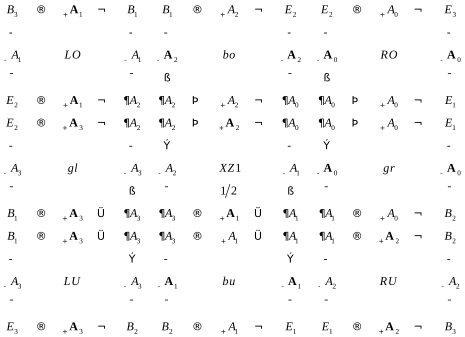
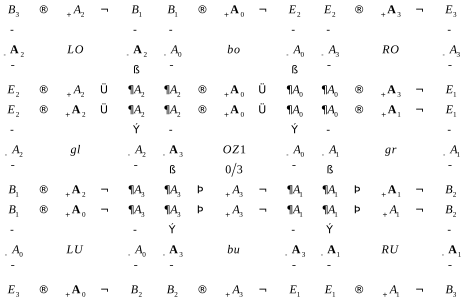
μ = 0: stat. vac. (++)/(−+), photon of light (+−)/(−−)
μ = 3: stat. vac. (−+)/(++), photon of light (−−)/(+−)
photon of light: μ = 1: (++)/(−+), μ = 2: (++)/(−+)
show the correlation structure of a linearly polarized E2/B1 deactivated photon, embedded in the deactivated virtual vacuum. Based on the conditions of the Hamilton’s principle, the currents of the photon induce a correlation structure of the vacuum around its own structure, forming a coherent spatial region around the photon; the dynamic photon of the vacuum is part of static photons of vacuum, both are linked together. This example shows the entanglement of the deactivated photon of light with the static photon of deactivated vacuum. The entanglement of the transverse oscillators with the deactivated vacuum promotes the formation of the following state in vacuum and the propagation of photons of light in vacuum. The entangled system consisting of the deactivated photon of light and the photons of vacuum creates the de-localization of the photon.
The propagation of the photon also takes place under the conditions of the Hamiltonian principle, in that during the formation of an oscillation state of the photon in the direction of the vertical correlations in the vacuum, a structure is formed with the properties of the structure of the photon in the following state, into which the currents flow into the adjacent structure during the following oscillation. This is shown in Figure 8 using the example of the μ = 3 oscillator. The light propagation of photons will be discussed again below (Section 4.5).
3.6. Entanglement of Photons, Gravitons and Photons of the Maxwell Vacuum
The formation of photons or gravitons by entanglement takes place under the conditions of the Hamiltonian principle. This will be discussed at the example of the formation of the entanglement of deactivated photons of light with the deactivated vacuum (3.2). Under the conditions of the Hamiltonian principle, each current in the correlation structure of the photon of light generates a common resulting current in the correlation structure of the deactivated vacuum, which superimposes the photon. This is shown by means of an excerpt for the μ = 0 oscillator of (3.2) in the following relations.
(3.3) OZ1(−)&XZ1(+)
We consider the
oscillator which may generate the action in the deactivated photon of light. The photon of light is active in the two parts bo of (0/3) and gr of (1/2), while the two other four-blocks RO and CE (of XZ1 and OZ1) are parts of the photon of deactivated static vacuum. The two parts (1/2) and (0/3) overlap, forming a common current in a three dimensional structure.
Figure 8 shows the course of the currents in (3.3) of the upper right part of the structure (3.2). They are the two parts RO and CE (center) of the static photons and the two parts bo and gr of the parts of the dynamic photon. The two parts of the static and dynamic photons are deactivated by themselves, since their currents in the unit cubes have the same directions of circulation and different signs. The correlations of the commutators for the μ = 0 oscillator are highlighted in bold. The parts (1/2) of the two photons O and X were superimposed in the upper structure and the parts (0/3) of the two photons O and X in the lower part of the structure. The section of the structure (3.2) shows the state Z1 of the two superimposed deactivated photons. In order to obtain the section of the photon O-X, both parts (1/2) and (0/3) must also be superimposed. Because the related currents are parallel and equally directed, the superposition then leads to constructive addition for some currents and destructive addition for others. In particular, the two photons—the deactivated dynamic photon and the deactivated static photon of the vacuum—form a common structure with common currents. The outward-facing correlations indicate the further connection of the structure with neighboring structures. If one of the photons—e.g., the photon of light—is activated by action, then the entire area, including the environment, is also activated. This causes the de-localization of elementary objects.
![]()
Figure 8. Spatial representation of currents in a part (3.2) of a superposition of photons of deactivated vacuum and photons of dynamic deactivated vacuum. Positive currents represented by continuous lines and arrows and negative currents by discontinuous lines and arrows. The currents of the μ = 0 oscillator are described by bold lines. Arrows describe correlations.
The common structures of static deactivated vacuum and dynamic deactivated vacuum have parallel and rectified correlations at all related points and, according to Figure 8, form a uniform structure with common uniform currents. They consist of two different photons that oscillate in two states. In an undisturbed system of the vacuum, therefore, the static and dynamic photons are entangled. In such a system, structural information moves timelessly, as long as there are no external disturbances.
If gravitons are introduced into such a system of deactivated vacuum in such a way that they also have a uniform pattern with parallel correlations aligned in the same direction, the assignment according to
(3.4a)
OZ1(1/2)RO-XZ1(0/3)CE = (++)/(−−)
XZ1(1/2)RO-OZ1(0/3)CE = (−+)/(+−)
OZ2(1/2)RO-XZ2(0/3)CE = (−−)/(++)
XZ2(1/2)RO-OZ2(0/3)CE = (−+)/(+−)
is obtained. Then, in this system of deactivated vacuum, the gravitons fit seamlessly and have common structures and common currents. The deactivated virtual vacuum, together with the gravitons, then forms an entangled system and, by inserting gravity in this form, also becomes a system in which structures of the photons of the deactivated light can move timelessly.
Finally, this also applies to structures of the photons of activated light, provided that these structures have the shape
(3.4b)
OZ1(1/2)gr-OZ2(0/3)bo = (+−)/(−+)
OZ2(1/2)gr-OZ1(0/3)bo = (++)/(−−)
XZ1(1/2)gr-XZ2(0/3)bo = (−+)/(+−)
XZ2(1/2)gr-XZ1(0/3)bo = (−−)/(++)
Since the introduced photons transport information in the form of action, they move at the speed of light, but are entangled with the Maxwell vacuum, consisting of deactivated vacuum and gravitons.
The interaction described in this section between photons of light, the deactivated vacuum, and the gravitons forming entanglement, represents the ideal case in which the overlapping structures all have parallel and rectified currents. In the general case, the activated photon will induce the parallel alignment of the currents in the surrounding vacuum, thus forcing entanglement.
3.7. Interaction of Static Photons with Gravitons
The interaction of gravitons with the static photons of particles and anti-par- ticles is carried out by superposition. This is shown at the following example, [4].
(3.5) Anti-particle part of graviton, state Z1 (particle state); active real negative O(−)-X(−) photon
O(−)-photon
Gravitons:
O(−)-photon:
+ Δg(+OZ1−XZ1); (1/2)/(0/3) = (−+)/(+−)+(++)/(−−)
Particle part of graviton, state Z1 (particle state); active real negative
X(−)-photon
(+)
Gravitons:
X(+)-photon:
+ Δg(+XZ2−OZ2); (1/2)/(0/3) = (+−)/(−+)+(−−)/(++)
The example shows the interaction of a static O(−)-X(−)-photon of negative charges in the particle state (with particle properties) with a graviton consisting of the two parts O(−)-X(+) and O(+)-X(−). For the sake of simplicity, only the range of the μ = 0 oscillator is reproduced. Only photons with rectified correlations (current directions) superpose. In the interaction, the currents are added, which changes the action. It is processed in the form of a four-dimensional delta as shown in Section 3.4.
3.8. Interaction of Gravitons with Mass Oscillators
Objects with mass and charge form a unit together with their photon cloud and gravitons. In detail, the photon cloud consists of the static photons to which the gravitons are superimposed; In addition, it will be assumed that there are also free gravitons in the vicinity of the elementary objects, which are only bound to the mass oscillators. From the point of view of the PIT, the photons of the photon cloud and the gravitons in the rest frame form a balance of the action with the action contained in the mass and charge oscillators (Section 3.12). To do this, the static photons and gravitons must interact with the surface of the charge and mass oscillators. This interaction is under the condition of the Hamiltonian principle: the currents of the photons and gravitons superimpose the currents in the surface of the mass/charge oscillators while minimizing the action. Minimizing the action causes the action formed in the photons to be minimized, and thus also the action of the surface of the mass and charge oscillators. An almost neutral surface of the charge and mass oscillators is formed.
If one determines the currents in the gravitons and in the mass oscillators (2.10), then some of these gravitons are fed by the mass oscillators with virtual action, others remain in the form as they exist in a vacuum. After interaction with the mass oscillators, the following gravitons are formed, [15] (sign in brackets describe positive action by “+”, negative action by “−” and cancel of action by superposition of currents by “0”):
(3.6a)
G1α-C: μ = 0: O(0)-X(0), μ = 3 O(0)-X(0)
G1β-A: μ = 0: O(0)-X(0), μ = 3: O(0)-X(0)
G2α-B: μ = 0: O(0)-X(0), μ = 3: O(0)-X(0)
G2β-D: μ = 0: O(0)-X(0), μ = 3: O(0)-X(0)
(3.6b)
G1α-D: μ = 0: O(+)-X(−), μ = 3: O(−)-X(+)
G1β-B: μ = 0: O(−)-X(+), μ = 3: O(+)-X (−)
G2α-A: μ = 0: O(+)-X(−), μ = 3: O(−)-X(+)
G2β-C: μ = 0: O(−)-X(+), μ = 3: O(+)-X(−)
In states Ω1(A,B), the current directions are opposite to Ω2(C,D). As a result of the superposition of the gravitons with the surface of the basic structure, the gravitons G1β-A and G2α-B with deleted action and the states G1β-B and G2α-A with virtual activated action in the longitudinal direction are formed in state Ω1(A,B). The same applies to state Ω2(C,D), in which the gravitons G1α-C and G2β-D have the deleted action and the states G1α-D and G2β-C have activated virtual action. Since Ω1(A) gives rise to the state Ω2(C) at the oscillation, and accordingly to the state Ω2(D) from Ω1(B), the gravitons alternate between the states between one in which the action disappears (is deleted by an overlap of positive and negative currents) in a graviton and one in which the virtual action is activated. In each state, two states with virtual action are activated and two with vanishing action. The oscillation occurs in the following way8:
(3.6c)
Ω1(A): G1β-A: μ = 0: O(0)-X(0), μ = 3: O(0)-X(0)
Ω2(C): G2β-C: μ = 0: O(−)-X(+). μ = 3: O(+)-X(−)
Ω1(B): G1β-B: μ = 0: O(−)-X(+), μ = 3: O(+)-X(−)
Ω2(D): G2β-D: μ = 0: O(0)-X(0), μ = 3: O(0)-X(0)
Ω1(A): G2α-B: μ = 0: O(0)-X(0), μ = 3: O(0)-X(0)
Ω2(D): G1α-D: μ = 0: O(+)-X(−), μ = 3: O(−)-X(+)
Ω1(B): G2α-A: μ = 0: O(+)-X(−), μ = 3: O(−)-X(+)
Ω2(C): G1α-C: μ = 0: O(0)-X(0), μ = 3: O(0)-X(0)
This oscillation corresponds to the one with charges, in which one of the two photon states has extinguished the action and one in which the action is real. In the real state, the interaction takes place in the photon cloud, and in the state with the erased action, the absorbed information is transferred to the oscillators of the charges, where it is used to change the canonical momenta. The difference between gravitons and charges is that in gravitation, in both states Ω1 and Ω2, states with vanishing action in the gravitons, as well as states with active virtual action occur simultaneously. This means that the mass in any state in one graviton can absorb information and process virtual action from another graviton: in each state interaction and absorption of information can occur. Comparable behavior is obtained for the magnetic interactions, [3].
3.9. Interaction of the Static Photons with the Charge Oscillators in Wave Properties
In the interaction of the static photons with the oscillators of the charges, a distinction must be made between the particle and wave properties. Due to the formation of static photons on the surface of the charge oscillators, under the conditions of the Hamiltonian principle the action is reduced. Two different photons α and β with wave properties are formed, each of which docks to the two different oscillators of the basic structure in both states Ω1 with A and with B and in state Ω2 with C and D, while reducing the action of the surface of the basic structure. The transverse oscillators in the unit cubes and in the adjacent four-blocks are extinguished by superimposing positive and negative currents. In the two oscillation states of the basic structure Ω1 and Ω2, the following static photons with wave properties are then activated, [15], (signs in the parentheses are signs of the action, zero means action is deactivated by an overlap of positive and negative currents):
(3.7)
Ω1: W1α-C: μ = 0 O(0)-X(+), μ = 3 O(+)-X(−); four-block μ = 3:(−)
Ω1: W1α-D: μ = 0 O(+)-X(0), μ = 3 O(0)-X(0); four-block μ = 3: (−)
Ω1: W2β-C: μ = 0 O(−)-X(0), μ = 3 O(+)-X(−); four-block μ = 3: (−)
Ω1: W2β-D: μ = 0 O(0)-X(−),μ = 3 O(0)-X(0); four-block μ = 3: (−)
Ω2: W1β-A: μ = 0 O(+)-X(0), μ = 3 O(0)-X(0); four-block μ = 3: (+)
Ω2: W1β-B: μ = 0 O(0)-X(+),μ = 3 O(+)-X(−); four-block μ = 3: (+)
Ω2: W2α-A: μ = 0 O(0)-X(−),μ = 3 O(0)-X(0); four-block μ = 3: (+)
Ω2: W2α-B: μ = 0 O(−)-X(0), μ = 3 O(+)-X(−); four-block μ = 3: (+)
In wave properties, all four photons of a state Ω1 superimpose to form a photon of static Maxwell fields W1α-C/Wα1-D/ W2β-C/ W2β-D and this passes into state Ω2 to form the superposition W1β-A/ W1β-B/ W2α-A/ W2α-B. In addition to the transverse oscillators, the contributions of the μ = 0 oscillator are extinguished in each state, while the μ = 3 oscillator forms a virtual action. In state Ω1, the μ = 3 four-block with real negative action and state Ω2 with real positive action remains. The μ = 3 four-block carries the activation of the E3 fields (cf. (2.6)). In the case of interference under superposition of the two states Ω1 and Ω2, these states also cancel each other out, which is proof of the wave properties.
3.10. Interaction of Static Photons with Charge Oscillators in Particle Properties
The wave properties of a particle or anti-particle turn into particle properties when an interaction takes place with an exchange of real action, [13]. In particle properties, the two oscillation states Z1 and Z2 are different. In state Ω1 of the basic structure, the particle in its state Z2 has a real positive action in the photon cloud and the anti-particle in its state Z1 has a real negative action. We call these states particle states because they only occur in the particle properties. State Ω2 of the basic structure forms the exchange states of particle Z1 and anti-particle Z2. In the exchange state the basic structure transmits action to the photons, but deletes them by superposition between the commutator and spin correlations of the photons. The following are the signs of action for the longitudinal oscillators, all transverse oscillators are deleted, [15].
(3.8)
particle state:
Ω1: particle Z2 Ω1: anti-particle Z1
A: μ = 0: O(0)-X(−), μ = 3: O(0)-X(+), A: μ = 0: O(0)-X(+), μ = 3: O(0)-X(−)
B: μ = 0: O(−)-X(0), μ = 3: O(+)-X(0), B: μ = 0: O(+)-X(0), μ = 3: O(−)-X(0)
exchange state:
Ω2: particle Z1 Ω2: anti-particle Z2
C: μ = 0: O(0)-X(+), μ = 3: O(+)-X(0), C: μ = 0: O(−)-X(0), μ = 3: O(0)-X(−)
D: μ = 0: O(+)-X(0), μ = 3: O(0)-X(+), D: μ = 0: O(0)-X(−), μ = 3: O(−)-X(0)
When the photons of particles and anti-particles are superimposed in the particle state, the currents in the longitudinal oscillators are extinguished and in the exchange state they form virtual action. The formation of virtual action in exchange state and the deletion of action by different sign of real action in both longitudinal oscillators in particle properties determine the interaction properties of charges with different signs in the photon cloud.
The different signs of the action in the longitudinal oscillators in the particle state for particle properties: positive in μ = 3 and negative in μ = 0 for the particle, and negative in μ = 3 and positive in μ = 0 for the anti-particle, determine the properties of the charges by causing active real action in the photon cloud and the activation of the E-fields. The function of the action transferred to the exchange state in the longitudinal oscillators and extinguished by superposition of the currents: positive action on the particle and negative action on the anti-particle, can be interpreted using the example of the interaction between charges. The action of the charges is unchangeable, in contrast to the mass. Therefore, the action transferred to the exchange state has a fixed invariable amount. In order to bring two charges of the same sign together, activated virtual action must be introduced into the charges. This increases the amount of action between the two interaction partners in their photon cloud. The charges will move away from each other in a decreasing gradient. If two charges of different signs are brought together, positive and negative real action overlap to form virtual action; the real action is reduced in the photon cloud and the formed virtual action is converted into movement of the charges to each other.
In a rest frame, if a charge is introduced into a potential of the sign of the charge, then the charge remains in its rest frame and the charge takes on the action of the increased potential in the photon cloud. If the charge is in a homogeneous potential of the same sign, then the photon cloud of the charge contains the action of the surrounding potential, while the basic structure of the charge has the lesser action of the rest frame, [14]. Ideally, the charge remains in its rest frame, because the absorbed action from one direction is compensated by the simultaneously absorbed action from the opposite direction. If such a charge moves in a decreasing gradient, it absorbs the action from the photon cloud into the basic structure under acceleration. After leaving the potential, the action of the movement relative to the rest frame is equal to the original action in the potential. In the new rest frame without potential, the action in the basic structure is equal to the action in the photon cloud.
3.11. Sign Formation in Charges
In the vertical side faces of the cubes in the basic structure, all four negative currents of the four O-X commutators contribute to the formation of the negative circulations and all four positive currents of the four O-X commutators contribute to the formation of the positive circulations in the vertical faces, Figure 4. The two circuits, the negative and the positive within the vertical faces of the cube, each form a total from four O and X contributions of action of the unit cube. The action of the four O-X commutators therefore forms a unit in the cube of the basic structure. This unit is formed by an active and a non-active O-X oscillator. Since the sign change in the cubes is similar to that outside of the cubes, i.e., the outer sign change continues inside the cubes, the double negative and double positive vertical circulations in the cubes form the circulations of currents.
In a cube, the positive and negative circulations have opposite circulated directions of currents. If the direction of circulation and the current sign are opposite, then the action of both circuits has the same sign. If we again assign a sign to the currents and a negative sign to the circulation in a clockwise direction, then the four parts of the basic structure can be characterized by their orbits for the two longitudinal oscillators in Figure 12 as shown in Table 1.
Table 1. Assignment of the signs of the orbits in the cubes of the basic structure to particles and anti-particles in particle properties for the longitudinal oscillators.
In basic structure the signs of action are always different for the two longitudinal oscillators. Because the circulation direction in particle and anti-particle is opposite, their longitudinal oscillators receive always different signs. For each static photon, which receives their action from the basic structure, the cubes have a positive or negative sign of the action. When the photons of a state Ω are superimposed, the positive and negative components are truncated; for example, when the photons of A and B or C and D are superimposed. As a result, the action in the static photons is minimized. Between the two states of the basic structure, the direction of circulation of the currents changes, whereby the sign of the action generated by them changes.
The adjacent circuits in the vertical planes of the same sign as the current in the cubes are connected with each other by currents to the creators and annihilators; the orbits of the neighboring cubes are opposite. During oscillation, they therefore represent a wave-like structure that propagates over the entire basic structure. In closed systems, they form a uniform oscillation system.
In wave properties, there is a coupling of the oscillation of the static photons with the oscillators of the basic structure. Since the wavelength of the matter waves depends on the transmitted action (energy, momentum), the wavelength in the rest frame of the wave should be determined in relation to the action in the vacuum (Section 4.3).
3.12. Equilibrium between Photons/Gravitons and the Basic Structure
Figure 9 shows a model of the μ = 3 oscillator of a one-dimensional particle in its exchange and particle state. We assume that the basic structure consists of a layer formed by two unit-cubes coupled together. The coupling of the unit cubes of the basic structure in the vertical direction is done by superimposing the currents of the same sign and direction between the unit cubes of the basic structure. In this case, the same states of static photons are deposited vertically upwards and vertically downwards. The components of the spin should also point in this direction. Such a system is in its rest frame, when the action in the two oscillators (top and bottom of the image) of the static photons contain the same action as in the two unit-cubes of the basic structure assigned to the photons. In the horizontal correlations of the particle, one oscillator overlaps constructively and the other destructively. If one follows the course of the constructively overlapping or the destructively overlapping correlations of the oscillators between the structure of the photon (e.g., from above) via the structures of the basic structure to the structure of the other (lower) photon, then they are connected to each other. They are linked by a common oscillating current: the static photons have the same action as the action of the basic structure. The equilibrium is caused by the counter-oscillating vertical correlations.
This equilibrium applies to all rest frames of the object in both states and is formed by the action of the photons and by the action of the oscillators of the basic structure. The action of the basic structure consists of a fraction of the mass formed by the non-active four-blocks and by the action in the O-X oscillators of the active four-blocks. The relative velocity of the object in the rest frame is determined by the virtual action in the active four-blocks.
The mass—represented by the non-active four-blocks—only becomes effective when the vertical correlations in the non-active four-blocks are activated by interaction. The static photons have the same action in both directions (up and down), which is equal to the action in the unit cubes of the basic structure. In the rest frame, the direction of movement does not matter; all rest frames with the same action are identical in terms of absorbed action, the speed of propagation is the same in all directions. Changes in propagation and thus also changes in speed and the direction of movement only occur during the interaction. The interaction occurs in the photon cloud under formation of deltas of action and their absorption in the basic structure.
The velocity of the matter wave is not equal to the speed of light in the rest frame, because the vertical correlations of the active and non-active four-blocks do not overlap, and because the oscillation of the photon cloud counteract simultaneously the oscillation of the active four-blocks. The inertness of the mass is directly related to the reduced velocity of the object in relation to the speed of light (which result is in contradiction to the present standard model in physics; see discussion in Section 5.1.).
Figure 9. One dimensional model for the simulation of the equilibrium of action in a rest frame of a particle.
3.13. The Non-Relativistic Limit (NRL)
An analysis of the basic structures shows that it can be considered as two interlocking four-block systems, Figure 4 and Figure 5. Each of the four-block-systems consist of two four-blocks with different currents signs connecting the four unit-cubes. The two interlocking four-block systems are distinguished by the vertical correlations running at the corners of the four-block systems, which point in opposite directions in each state in the two systems and reverse the directions when the state changes. One of the two four-block systems is connected to the gravitons and to the static photons, the other oscillates in any state to this in the opposite direction. The four-block system, which is connected to the static photons and to the gravitons, is always in interaction with them and determines the results obtained in the previous sections, while the other four-block system is only indirectly connected to the photons and gravitons via the internal correlations in the cubes. We assume that the non-active four-block has stored a fixed proportion of the action, which determines the properties of the masses or charges.
If in the non-relativistic case this proportion of the action in the non-active four-block system is greater than in the active four-block system, then the relative velocity changes with the supply of action in an acceleration, without an increase in mass, until both four-block systems have stored the same action. With a further supply of action at an acceleration, both four-block systems are now filled, which corresponds to a relativistic increase in mass. We want to call the acceleration state in which the action is the same in both four-block systems the non-relativistic limit (NRL), [6].
Figure 10. Spatial representation of the relation between the μ = 3 oscillator of a static photon of an anti-particle to the μ = 0 oscillator of the basic structure for the particle- and exchange-state.
Figure 10 shows the relation of the μ = 3 oscillator of the static photon of the anti-particle to the μ = 0 oscillator of the basic structure for the two oscillation states Z1 and Z2. The linking of the vertical correlations of the active four-blocks of the basic structure with the vertical correlations of the static photon is marked by dotted lines. In the particle state Z1, for an anti-particle these point downwards in the static photon and upwards in the active part of the basic structure. In the transition to the exchange state, all directions are reversed.
In static photons the vertical correlations are opposite to the active vertical correlations of the basic structure. In the basic structure, the non-active vertical correlations point in the opposite direction to the active ones. The lower level of static photons is linked to the upper level of the basic structure; in both planes all currents assigned to each other have the same direction. In the case of anti-particle, the currents of the O-photon add up for negative action, while the currents of the X-photon cancel each other. Correspondingly, the opposite is true for the relationship of the static photons O and X of the anti-particle for the interaction between B and D (not shown in Figure 10). Because the vertical correlations between two planes with different oscillation directions in general have different directions and different signs, the flow of information does not depend on the direction and sign of the correlations, but on the conditions of the Hamilton principle.
In the interaction, a four-block as a delta is always transmitted, including the vector components. Below the NRL, these are only added (or removed) to the active parts of the four-block. The non-active four-blocks therefore remain unchanged below NRL. Above the NRL, the conditions of the Hamilton principle ensure that the supplied deltas of the four-blocks are also added to the non-active four-blocks, which increases the relativistic mass.
The transverse oscillators of particles and anti-particles are erased, which is associated with the isolation of the two longitudinal oscillators in the photon cloud. The μ = 0 oscillator of the basic structure in Figure 10 thus only provides the information of the action to the μ = 3 oscillator of the static photons of particles and anti-particles. In an interaction, the μ = 1,2 coordinates of space-time are activated in the static photons as a result of the connections to the transverse and longitudinal peripheral four-blocks.
3.14. Memory of Charges in the Basic Structure
As can be seen from Figure 13, in each oscillation state Ω1(A,B) and Ω2(C,D) in a rest frame between the superimposed planes of the gravitons and the basic structure, the two oscillators O and X are completely erased in one part of gravitons (gravitons with superimposed currents of different signs). If the action in an interaction changes, information can then be transmitted between the basic structure and gravitons along all these channels. In the case of static photons, on the other hand, only one of the two oscillators O or X is extinguished, while the other is constructively superimposed. In detail for a particle and anti-particle, according to Figure 12 for the μ = 3 oscillator, the following transitions between static photons and the basic structure are present (signs in brackets are sings of action):
Particle, μ = 3
Exchange state Z1 Ω2: C: O(+), X(0); D: O(0), X(+)
Particle state Z2 Ω1: A: O(0), X(+), B: O(+), X(0)
Anti-particle, μ = 3
Exchange state Z2 Ω1: A: O(−), X(0), B: O(0), X(−)
Particle state Z1 Ω2: C: O(0), X(−), D: O(−), X(0). (3.9)
The effect of this in teraction between the basic structure and one of the static photons is shown in Figure 11, using the example of a particle for the two states Ω1 and Ω2 in the two four-blocks A and B or C and D. The interaction in the common plane between the basic structure and static photons, which takes place with a transmission of the same information, i.e., with a constructive superposition of the two oscillators, is in Figure 11 emphasized in the four-blocks by reinforced lines. Parallel to this are the currents which, as with gravitons of Figure 13, are extinguished between the two planes. These are represented by faint lines in Figure 11. Both currents in the basic structure, which are formed by constructive superposition and those by destructive superposition, interact with the static photons of the particle.
![]()
Figure 11. Spatial representation of charge formation in the four-blocks of basic structure of the particle by an activation of one of the oscillators O or X. The currents of the basic structure forming the charges in the photon cloud are depicted by strong lines; positive current by continuous lines, negative by discontinuous lines.
The constant action of the charge should be contained by a constant action in the constructively superimposed currents, because these determine the content of the action in the photon cloud. We therefore assume that the superimposed currents of the basic structure and static photons determine the positive charge of the particle and ask about the properties of the memories of the constant charge and the memories for the interaction of the charges with each other. Virtual action in the basic structure is always formed by the same positive and negative action. Since the unit cubes of the four-blocks in the basic structure are always connected by currents of the same sign, both four-blocks with positive and negative currents of a state become effective for the storage of a fixed charge memory. In the particle state, therefore, the positive currents form the four-block A and the negative currents form the four-block B, which causes an overall neutralization of the action. In the exchange state, the positive currents form the four-block C and the negative currents form the four-block D. The oscillation between the superimposed currents of the basic structure and static photons oscillates for positive currents between Ω1(A) and Ω2(C) and the negative currents between Ω1(B) and Ω2(D).
In detail, the coordinated oscillation between the two states Ω1 and Ω2 takes place as follows, Figure 11: in state Ω1(A), the two creators lie in the upper plane and generate a positive current towards the annihilators of the lower plane. At the same time, in state Ω1(B), a negative current is generated in the upper plane, which has the opposite direction of circulation in relation to state Ω1(A) and runs to the annihilators in the lower plane. In state Ω2(D), a negative current run from creators of the lower plane back to the annihilators in the upper plane, and in state Ω2(C), a positive current from the creators in the lower plane in the opposite direction of circulation to the upper plane. To simplify things, the constructively generated positive and negative currents in Figure 11 run from the upper plane to the lower plane in state Ω1 and back from the lower plane to the upper plane in state Ω2. The two states Ω1(A) and Ω1(B) and correspondingly the states Ω2(C) and Ω2(D) ares linked to each other via the longitudinal oscillators. All destructively generated currents between the basic structure and static photons run in the opposite direction to the constructively formed ones.
The oscillation of the currents of action of a positive charge occurs in the basic structure and determines the oscillation of the positive charge of the particle in the photon cloud. Superimposed on this oscillator for the constant value of the action, which determines the positive charge of the particles, is the destructively superimposed current between the basic structure and static photons, which contains the change in the action as a result of the interaction under charges. As can be seen from Figure 11, it oscillates with the same sign of the current, but in the opposite direction of circulation in the four-block. The oscillation of the constructively and destructively formed currents is always carried out in such a way that the currents of both oscillators overlap only in the vertical correlations. This means that the action as a result of the interaction is stored in the horizontal correlations, regardless of the action produced by the charge.
For the anti-particle a similar oscillation system in the basic structure can be formed. As discussed the four-block form a network, in which the four-blocks are connected with each other. For the charges and matter oscillators they will be closed under formation of a constant amount of action. At present it is only possible to study the single four-blocks.
From this formation of basic structure and static photons, one can develop a scenario of the formation of mass and charge oscillators during the Big Bang: In a Big Bang, fragments of the basic structure are formed and the deactivated vacuum exists (together with gravitons): the fragments of the basic structure react under conditions of the Hamilton principle with their surface with the correlations of the vacuum in three different ways. Since the fragments of the basic structure consist of two different states and two different four-blocks that emerge from each other: Ω1(A,B) and Ω2(C,D), there are three different types of reactions: one for positive, one for negative charges and one for gravitons, whereby the basic building blocks of charges and mass are formed.
3.15. Formation of Inertia
For the analysis of the inertia of the masses, the two superimposed two layers of the basic structure are considered in Figure 9. The basic structure consists of superimposed layers of the two states Ω1 and Ω2. In different states the correlations always run in the opposite direction, but in forming the basic structure they overlap along their connection plane with rectified horizontal currents. Correlations of the active and non-active four-blocks overlap in the horizontal rectified correlations. In each layer, there are two vertical correlations of the positive and two of the negative currents of the active four-blocks in one direction, and the same correlations of the non-active four-blocks in the opposite direction. In the following layer (which corresponds to the following oscillation phase), all vertical correlations are in the opposite direction. Any change in the currents as a result of an interaction causes the same change in the currents simultaneously in all vertical correlations. The inertia of the masses is caused by the oscillation process of the basic structure, which occurs pairwise in all vertical correlations simultaneously in the opposite directions.
3.16. Difference between Particles, Anti-Particles and Gravitons
In order to analyze the difference between the particles and anti-particles among themselves and in relation to the gravitons, the local interaction of the μ = 3 oscillator (which in basic structure overlap with the μ = 0 oscillator) of the static photons and the gravitons with the associated basic structure is shown in Figure 12 and Figure 13. The two states of particles and anti-particles and two states of gravitons are shown in relation to the basic structure, whereby two further states of the gravitons with activated action to the basic structure are not reproduced, but they can be derived from the representation in Figure 13. The relation of all photons and gravitons to the basic structure is always based on the fact that the currents in the lower plane of the photons and gravitons are parallel and rectified to the currents of the basic structure. As already discussed in section 3.4, this interaction between the μ = 3 oscillator of photons/gravitons with the μ = 0 oscillator of the basic structure leads to the following results (in brackets positive, negative and zero action), [15]:
Particle, exchange state Z1: Ω2:C: X(0), O(+), Ω2:D: X(+), O(0),
results in: O(+)-X(+)
Particle, particle state Z2: Ω1:A: X(+), O(0), Ω1:B: X(0), O(+),
results in: O(+)-X(+)
Anti-particle, exchange state Z2: Ω1:A: X(0), O(−), Ω1:B: X(−), O(0),
results in: O(−)-X(−)
Anti-particle, particle state Z1: Ω1:C: X(−), O(0), Ω2:D: X(0), O(−),
results in: O(−)-X(−)
Graviton G1: Ω2:C: X(0), O(0), Ω2:D: X(0), O(0),
results in: O(0)-X(0) and O(0)-X(0)
Graviton G2: Ω1:A: X(0), O(0), Ω1:B: X(0), O(0),
results in: O(0)-X(0) and O(0)-X(0)
Graviton G1: Ω2:D: X(+), O(−), Ω1:B: X(−), O(+),
results in: O(−)-X(+) and O(+)-X(−)
Graviton G2: Ω2:C: X(−), O(+), Ω1:A: X(+), O(−),
results in: O(+)-X(−) and O(−)-X(+)
If one thinks of the simultaneous formation of the basic structure and the photons of the vacuum and if one assumes that the formation of particles, anti-particles and gravitons occurs by interaction between the basic structure and the vacuum under the conditions of the Hamilton’s principle, then the interaction, shown in Figure 12 and Figure 13, represents the possible results of this interaction for the μ = 3 oscillator. Depending on which connection of the basic structure takes place, elements of particles, anti-particles and gravitons are formed under the condition of minimizing the action of the basic structure.
Figure 12. Comparison of the interaction of the μ = 3 oscillator of the static photon with the basic structure between particle and anti-particle.
Figure 13. Interaction of the gravitons with the basic structure at the example of the μ = 3 oscillator, only the gravitons with annihilated currents are depicted.
The formation of particles, anti-particles and the associated nuclei from the photons of particles, anti-particles and gravitons cannot be pursued further from the current point of view of the PIT, because this is an organization of a large number of oscillators, which is currently not possible on the basis of the properties of the oscillators of the basic structure and the photons/gravitons alone.
All elemental objects are formed by four-blocks; the interaction always takes place in four-blocks, the two longitudinal oscillators are always linked to each other in four-blocks. If in a state Z2 in the interaction with the basic structure in state Ω1 has formed negative action in the μ = 0 oscillator, then the Hamiltonian principle requires that positive action is formed in the μ = 3 oscillator. If in state Z1 and in the basic structure of Ω2 in the μ = 0 oscillator positive action is formed, then the Hamiltonian principle requires that in the μ = 3 oscillator negative action is formed. In the first case, photons of a particle are formed, in the second, of an anti-particle. If no action is formed in the interaction between photons of the vacuum and the basic structure in a state Ω1 or Ω2 in the μ = 0 oscillator, then no action is formed in the μ = 3 oscillator and no action is formed in the following state either. This corresponds to gravitons.
In these considerations, the formation of the charges is associated with the formation of the four dimensions and thus with the formation of space-time, because the μ = 3 oscillator is formed in the four-block under the action of the sign of the μ = 0 oscillator; the transverse oscillators are automatically formed, because the formation of the two independent longitudinal oscillators is associated with the deactivation of the transverse oscillators.
3.17. Oscillation of the Currents for Charge and Mass in a Unit Cube of the Basic Structure
Figure 14 describes the oscillation of the currents in the μ = 3 cube of the basic structure for a particle, for the active and non-active four-blocks A and B in the upper part and for the four-blocks C and D in the lower part of the image. It is assumed that the currents are sinusoidal. The correlation structure of the cube is indicated by information on the upper and lower levels with “up” and “down”, whereby the upper part is marked with -up for negative currents and the upper part with +up for positive currents. Currents with positive circulation run from left to right, and negative ones in the opposite direction. The signs for the current and its direction are additionally indicated in parentheses. The side-by-side representations of the currents for active and non-active four-blocks are actually superimposed. In this case, the to each other related currents of the active and non-active four-blocks are superimposed, have opposite direction of circulation, but the same signs of the currents; in the cube they are spatially separated and overlap only in horizontal correlations. This means that the action in both parts has opposite signs. The two parts A and B and C and D respectively have identical current signs. This corresponds with the similar properties of the two longitudinal oscillators in the basic structure. The current direction in A-B is opposite to the current direction in C-D, which results from the oscillation between the two states Ω1 and Ω2.
![]()
Figure 14. Oscillation of currents formed in the μ = 0 and μ = 3 unit-cubes of the basic structure; the discontinuous lines describe the currents in the four-block of the basic structure inducing the currents in static photons of a particle.
The positive currents are assigned to the four-blocks A and C, the negative ones to the four-blocks B and D (Figure 11). The sum of all currents is zero in each active part and in the non-active part. For the representation in Figure 14 it was assumed that the magnitude of the currents in the active and non-active parts is the same. If one considers the active and non-active as linked to each other, which is suggested by the diagram in Figure 14, then one obtains a continuous oscillation of all four currents, whereby two positive and two negative currents of the same current direction are superimposed. This corresponds to the requirement of the Hamilton Principle. If you note that in the basic structure the longitudinal oscillators overlap between A and B or C and D, then you get a uniform current curve for both the active and the non-active four-blocks. If the magnitudes of the action in the active and non-active four-blocks are different, then the symmetry obtained in Figure 14 disappears. For the anti-particle, the states Ω1 and Ω2 are swapped: in Ω1 the anti-particle has its exchange state and in Ω2 the particle state. The gravitons of the state G1 interact with the basic structure in Ω2(C,D) and in G2 with the state Ω1(A,B).
From the diagram of the basic structure, Figure 4, it can be seen that the oscillators O and X of the unit cube of the active four-block (and the same applies to the non-active four-block) each generate two currents, one positive and one negative, which form the currents of the four-blocks. If the positive current of an oscillator O of an active four-block forms the positive current of the four-block A (or C), then the positive current of the X oscillator of this cube forms the second current of the same four-block A (or C). Conversely, the negative currents of the two oscillators O and X at this cube then form the negative currents at the four-block B (or D). The active O-X oscillators each form two positive and two negative currents for the two four-blocks A and C (or B and D). The static photons of the particle with its positive charge (and accordingly for the anti-particle) are each connected to one of the two positive and negative currents, Figure 11, and as we assume, form the currents that generate the positive charge in the photon cloud. The other two positive and negative currents then form the currents that cause the change in the action in the interaction. These two currents are shown in Figure 14 in the active four-block areas.
Regardless, the non-active region of the four-block oscillates with the same currents with opposite direction of circulation. From the basic structure, it can be seen that each of the four currents of the active part of the four-block in the horizontal correlations with different signs superimposes the current with a current of the non-active four-block. For example, the positive current of the active X-oscillator overlaps with the negative current of the non-active O-oscillator and the negative current of the X-oscillator with the positive current of non-active O-oscillator.
The active currents of the four-block associated with the charge in the photon cloud are connected within the basic structure with the non-active currents of opposite signs via the horizontal correlations of the cube under consideration. Since the superposition in the cubes takes place in the same direction, as can be seen from Figure 4, the currents of the active and non-active parts of the four-block then have different current signs and the same direction of circulation. They then form a common oscillation direction. In the upper part A of Figure 14, for example, this is for the current (−+) in the area of the active part of the four-block, which continues in the non-active part of A in the current (++). The common oscillation of the currents of active and not-active four- blocks is the foundation of the inertia of masses.
The currents that form the charge in the basic structure consist of an active and a non-active current, each of which forms positive and negative four-blocks. The same applies to the currents that do not generate the charge in the photon cloud and represent storage of the action during the interaction. If we assume that the currents forming the charge in the active- and non-active four-blocks are filled with constant action, they form the constant charge of the oscillator. The currents running parallel to this with opposite direction of circulation then form the part of the oscillator that stores the action transmitted by interaction. In these, the active parts form the interaction by changing the relative motion and the non-active parts form the part of the mass of the charge.
The currents highlighted in Figure 11 describe the connection of the basic structure to the static photons of positive charge. From Figure 11 it follows for the μ = 0 oscillator that in the state Ω1 of the active four-block, a positive circulating current (−+) in A and a negative circulating current (+−) in B forms the positive charge. These two currents are highlighted in Figure 14 by discontinuous lines. Since the currents of the active and non-active four-block are superimposed in horizontal correlations of the vertical planes with double-circulating currents of the unit cubes in the basic structure, a common current is formed for these currents in the active and non-active four-blocks.
This is expressed in Figure 14 by the fact that the currents from the active four-block, which form the positive charge, seem to continue in the non-active four-block: the current (−+) flowing from -up to down becomes the current (++) in the non-active region of A, and in the non-active range the current (+−) coming from down and flowing to +up becomes the current (+−) flowing from +up in the active area. The currents present in the active and non-active four-blocks are linked to each other by the common oscillation between the creators and annihilators. For example, in the non-active area in down, the transition from (+−) to +up takes place at the same time as the transition of the current (+−) from +up in the active part to down. The same applies to all transitions into Ω1.
If we assume that these four currents in the active part of A, which generate a link between the currents in the static photons, via the currents in the active four-blocks to the non-active four-blocks, form the positive charge, then four more currents remain in the active and non-active four-blocks, which create the memory for the action of the mass and for the acceleration. For acceleration, the currents (++) and (−−) are present in the active part of A, which form a negative action in the active four-block. In the non-active part, the currents (−+), which are a continuation of the current (++) from the active part, and the currents (−−), which continue in the active part in the current (−−) from the non-active part, remain. While the positive currents in the non-active four-block (++) and (+−) form the action of the charge, the negative currents (−+) and (−−) in this four-block with opposite orbital directions will form the action of the mass.
Since the entire four-block is to be considered as the source of charge and mass, the participation of the four-block B with the contribution of the μ = 3 oscillator must be added to the oscillation, Figure 14: if part A has so far described the μ = 0 oscillator in our considerations, the part B also represents the μ = 3 oscillator. The four-block in Ω1 always describes the simultaneous oscillation of all four μ oscillators, the μ = 3 oscillator oscillates simultaneously with the μ = 0 oscillator: all creators of the four-block change to annihilator and all annihilators switch to creators at the same time. Therefore, during an oscillation process, one can consider the formation of charge, mass and acceleration as one unit. In Figure 14 one can consider the currents shown in B as a simultaneous process and the currents running in A can also be considered as a continuation of the currents formed in B.
This is expressed in Figure 14 by the fact that, for example, the currents marked by broken lines, which describe the positive charge, can be continued over all four sub-regions. The charge is then represented by the current (−−), which is formed in down at B, continues to -up, flows from there via down in B to A to +up, and finally ends +up in A again in down. The same applies to the other currents for mass and acceleration, which continue in state Ω1 over both parts A and B. In the four-block, the currents symbolically represent the oscillation mechanism in which, within a four-block, when the state Ω1 changes all creators become annihilators and all annihilators become creators. The representation C and D of the state Ω2 in Figure 14 describes the second phase of the oscillation, in which all currents in the four-block retain their sign and flow in opposite directions. The four-block is the basis for the formation of the action of charge, mass and acceleration.
3.18. Analysis of Anti-Matter
So far, particles and anti-particles have been analyzed in the basic structure based on the development of the correlation structure of static photons. Particles, anti-particles and gravitons interact in the same way with the basic structure, which describes the properties of the nucleus of these particles, i.e., electron, positron and mass. For particles, positive action was assumed in the μ = 3 oscillator, for anti-particles negative action and the gravitons are described by activate virtual action. The particle then describes positive charge in the particle state, anti-particle negative charge and the gravitons contain no charge.
Figure 15. Comparison of the interaction of the μ = 3 oscillator of the static photon with the basic structure between anti-matter-particle and anti-matter-anti-particle.
Figure 16. In a photon of an anti-matter-particle the position of the transverse and longitudinal oscillators in the four-block is exchanged. Exchanged are also the particle and exchange state.
We now start from the assumption that anti-matter differs from the elementary objects described so far, but can also be derived from the basic structure and choose the previously non-active four-blocks as the starting point for the anti-matter and its interaction with a “photon cloud” in the basic structure. The four-blocks previously referred to as active then become “non-active” four-blocks and take over the task of storing the information for anti-matter. In order to distinguish between the particles, anti-particles and gravitons of anti-matter, we assume the designation anti-matter or simply A for each of them; for a particle of anti-matter, e.g., anti-matter particles, or simply A-particles.
Figure 12 describes the interaction of particles, anti-particles and Figure 13 gravitons in their two oscillation states with the basic structure for the μ = 3 oscillator, which determines the sign of the charge. In Figure 15 in comparison to Figure 12 in the basic structure the oscillators of the photons for matter have been erased and in their place the oscillators of photons have been placed, which are in interaction with the “photon cloud” of the anti-matter. In comparison with Figure 12, you can see that the two states of particles and anti-particles change their sign during the transition to anti-matter, which is a characteristic of anti-matter. The basic structure can thus also be used as an output for the formation of the anti-matter and its photon cloud.
Of further interest is the shape of the photons of the photon cloud of anti-matter. To do this, we start from the μ = 3 oscillator for the anti-matter particle in the exchange state Z1 in Figure 15 and ask about the shape of the currents of the photon of the anti-matter particle. As Figure 16 shows, the arrangement of the O and X oscillators in the μ = 3 oscillator again forces the formation of a structure consisting of five four-blocks. However, in the structure of the anti-matter particle, the positions of the longitudinal and transverse oscillators are in the central four-block reversed. This gives the static photon of anti-matter a modified structure with altered properties. The structure of the anti-matter O-photon from (2.6) for an anti-matter particle is shown in the following correlation structure.
(3.10)
(3.10a)
(3.10b)
A comparison with the structure of (2.6) shows, that the conditions for the interaction of the static photons with the photons of light are also fulfilled: the photons of light are formed by the field-pairs E1/B2 and E2/B19, however, similar to the static photons, the positions of the unit cubes and the Ei and Bi fields are changed. An in-depth analysis of the anti-matter will be carried out elsewhere. It should only be noted here that due to the symmetry of the four μ-coordinates in the gravitons and in the structures of the deactivated vacuum and the fact that in these the E and B fields are deleted, the corresponding structures of the anti-matter remain largely unchanged.
Figure 17. The μ = 0 oscillator of the basic structure and the superposition of gravitons and anti-gravitons.
Figure 17 describes the μ = 0 oscillators of the cubes A and B in the basic structure. It also describes at the same time the superposition of gravitons and anti-gravitons. The two structures of the basic structure are identical to those of the superposition of gravitons and anti-gravitons, but the action contained in the structures is likely to be different in the basic structure and in the gravitons. The gravitons cannot convert into the deactivated vacuum and vice verse, because the commutators, i.e., the action, can only exchange signs between creators and annihilators of the same vector components. It remains unclear whether the anti-graviton is also part of the Maxwell vacuum. As discussed in Section 5.2, this will have an influence on the redshift of spectral lines in gravitation.
4. Interpretation of Physical Phenomena in Space-Time
By introducing the correlation space and interpreting the elementary objects as correlation structures with oscillator properties, an explanation for a number of physical effects is obtained deviating from interpretations of quantum mechanics. The correlation space provides some additional tools for this that are not available on space-time. By characterizing the elementary objects by action alone, properties and interaction can be interpreted solely on the basis of the Hamiltonian principle. The Hamiltonian principle proves to be particularly effective because the objects have a three-dimensional structure generated by four-dimen- sional fields and, due to their oscillator properties, a description of interactions by induction, superposition and entanglement is possible. It should also be noted that the study of oscillators of elementary objects takes place in a several orders of magnitude smaller dimension than when considering a wave function: A wave function of an electron represents a large number of oscillators of the static photons and the nucleus of the electron.
The objects in the PIT are relativistic invariant; the relativistic invariance already follows with the scalar oscillators, because after each interaction the correlation structures take on the same structure: on space-time described by a commutator between the canonical momenta. This can be explained by the fact that the information conveyed in an interaction always has the same structure—that of a four-block—whose magnitude, but not its structure, changes after an interaction (whereas in classical physics the relativistic description comes to complex expressions). It is the physical information that is characteristic of the objects in any rest frame, regardless of the amount, while the elementary objects themselves always retain their structure, [3].
The structures must comply with the Hamilton principle. In order to make the interpretation based on the Hamiltonian principle, the strings running between the components of the vector potential are interpreted as currents. In the following, a number of physical effects based on physical information theory are discussed, which lead to an interpretation that differs from quantum mechanics.
4.1. Superposition, Entanglement and Induction
The interactions: superposition, entanglement and induction occur on correlation space under conditions of the Hamilton principle. All three types of interaction take place with the participation of the deactivated Maxwell vacuum. It is assumed that the deactivated Maxwell vacuum is always present and provides the fields for the excitation of the action.
The interference experiments show that there is no interaction of the material waves (and similar the photons of light) with detector material when currents of different signs overlap. If the currents of the photons annihilate each other by superposition, they remain inactive for detector materials. Separating the phases of the photons, so that the currents not overlap, the currents become again active. This shows the property of the superimposed currents. In deviation to the superposition of photons, in entanglement in both oscillation states the sources and sinks of the currents are superimposed, and the superimposed photons are forming in both states the same structure.
Different examples are already discussed for the illustration of the entanglement. In the structures (3.2) the photon of light is completely embedded by the photon of deactivated vacuum: because of the structures of the photons of light and the photons of deactivated vacuum all currents are parallel and have the same circulation directions. The creators and annihilators and their currents of both structures superimpose and form a common structure with common current. Photons of light are therefore with the deactivated vacuum entangled, which is the reason for their properties, by forming a widely distributed system of oscillations in vacuum. This property explains a number of experiments which will be discussed in the following sections.
Another example of entanglement are the magnetic photons which in a rest frame are superimposing all four oscillation states in its interaction with the basic structure: two of M1 and two of E1, as well as two of M2 and two of E2. Similar entangled are in a rest frame the gravitons in their two oscillation states of the basic structure with the photons of the deactivated vacuum.
Induction can be interpreted on the correlation space: in a vacuum, the photon excites under conditions of the Hamilton principle a sequence of structures consisting of successive two states of oscillators that reverse their states in the rhythm of the advancing photon and are entangled with the active photon10. The induction contributes to the entanglement in a rest frame by the propagation of currents from the active oscillating photon into the neighbor formed structure in vacuum.
An exchange of signs between creator and annihilator causes the exchange of all (entangled) structures connected in the system. The advancing wave of the photon causes the formation of a system of entangled structures in its environment, in which the signs change in the rhythm of the sign change in the active photon. In space-time, this can be interpreted as the induction of currents, because the change in the sign on the correlation space is associated with an oscillation of the currents on space-time. However, the inducing part—the action—remains in the photon. The action is the difference of properties in the interacting positive and negative vector component.
4.2. Wave Particle Dualism of Material Waves
The wave-particle duality for matter waves has already been discussed, [16], by showing that the correlation structures of static photons have different properties in wave and particle properties. In the case of wave properties, there are two comparable states of static photons which, under the conditions of the Hamiltonian principle, largely delete the information transmitted by the basic structure. Since the waves in the successive states in the peripheral μ = 3 four-blocks of the static photons have currents of different signs in both states, action is extinguished when two states are superimposed, they therefore also comply with the Hamiltonian principle in space-time and are completely extinguished by interference.
There are two different states in the particle properties: a particle state that forms the characteristic charge in that the photon cloud in the longitudinal oscillators forms a real action with different signs: for the particle in Z2 for μ = 3 positive and for μ = 0 negative action, for the anti-particle in Z1 for μ = 3 negative and for μ = 0 positive action. The currents activated in the longitudinal oscillators by the real action in the two longitudinal peripheral four-blocks cause the formation of the Ei fields. This is shown in Figure 18, which shows the currents in the Ei-cubes of the peripheral four-blocks for the static photons of an anti-particles in its particle state Z1.
Figure 18. Current distribution in the anti-particle in its particle state Z1: an overlap of commutator and spin currents shows that the longitudinal peripheral four blocks are formed by positive and negative currents activating the E3 fields.
From the wave properties, particles, or anti-particles, are transported into particle properties by interaction under transition of real action in the form of a four-block (four-dimensional delta of the commutators). An interaction process begins in which, as described in Sections 3.3 and 3.4, the delta is integrated into the action of the oscillator, until a new equilibrium is formed and the action of the photons in the photon cloud is equal to the action in the absorbed state. After reaching this equilibrium, the object regains wave properties in a new rest frame. This is, because action compared to the particle properties is reduced: instead of real action in the particle state, virtual action in the longitudinal oscillators is formed.
4.3. Wavelengths of Matter Waves
A matter wave gets its wavelength from acceleration from a potential in the rest frame. If we consider the same matter wave from two different rest frames, then the same matter wave must have two different wavelengths, which appears to be a contradiction. This contradiction from the point of view of PIT can be explained by considering the formation of the matter wave of a charge moving in a homogeneous potential gradient.
For this purpose, a charge is considered in a homogeneous potential gradient. In the context of PIT, a charge in a homogeneous potential has the action of the potential stored only in its photon cloud, while the action in its basic structure (in the nucleus) is equal to the action in the rest frame (Section 3.15), [14]. When the charge moves in the gradient, the action of the potential is transferred from the photon cloud or from the potential to the basic structure, so that after leaving the potential, the kinetic energy is equal to the energy of the original potential. Since the energy or momentum is related to the wavelength of the matter wave (λ = h/p), the acceleration in a potential gradient from two different rest frames will apparently lead to the fact that the same matter wave with the same energy (momentum) has two different wavelengths (Figure 19).
![]()
Figure 19. From two different rest frames, the matter wave is accelerated to the same kinetic energy. Classically, the matter wave has wavelengths λ1 and λ2 at the same time. Seen from two different moving rest frames, the same matter wave has different wavelengths.
In the PIT, the rest frames 1 and 2 differ in the amount of action in the oscillators of the basic structure, from which the difference in the oscillation frequencies and thus the wavelength follows. To do this, the flows in the vertical planes of the unit cubes of the basic structure in Section 3.11 are considered. In the unit cubes of the basic structure, the action formed in the vertical circulations with different signs formed in the two four-blocks A and B or C and D is to be considered (Table 1). The photons of a state Ω1 or Ω2 with wave properties receive the signs of the basic structure in A and B, but have the same orbital directions, so that the contributions in the photon cloud between A and B are superimposed and deleted. As explained in Section 3.4, in a potential gradient the information is transmitted in the form of virtual action O+Δ-X+Δ. While in the photon cloud O and X in wave properties have different signs and cancel each other, the deltas from the potential gradient are added together:
Example:
Ω1: A(−−)/(++) + Δ(+−)/(−+) + B(+−)/(−+) + Δ(+−)/(−+) = 2Δ(+−)/(−+)
Ω2: C(−+)/(+−) + Δ(++)/(−−) + D(++)/(−−) + Δ(++)/(−−) = 2Δ(++)/(−−).
While the interaction occurs in the particle state and information is absorbed in the exchange state in the basic structure, the absorbed delta between the states changes sign. After leaving the gradient, under a relative motion with respect to the rest frame, the action of the static photons with wave properties differs by the amount of the action that determined the potential at the beginning of the gradient. The absorbed action is then located in equal parts in the photon cloud and in the basic structure and oscillates between the two states Ω1 and Ω2 with different signs.
As an explanation for the observable different wavelengths, Figure 19, it is therefore suitable for observing the properties of the matter waves in the rest frame. Wavelength λ1 is observed in rest frame 1 and wavelength λ2 in rest frame 2. In quantum mechanics, this is the difference between the momentum p1 for the rest frame 1 and the momentum p2 for the rest frame 2. In the PIT, it is the different values of the action of the wave compared to the two different rest systems. For the interpretation of these statements, therefore, the following considerations can be used: the formation of the wave phenomena of a matter wave is considered in a rest frame 1 or 2, i.e., that e.g., the wavelength is determined by the interaction of the matter wave with a detector system in the rest frame by means of the interferences. For the two states of the matter wave, the interaction takes place one after the other in time. The wavelength can be determined from the temporal segments. The temporal intervals of the interaction of the matter wave are determined by the oscillation frequency between the states. The oscillation frequency, in turn, depends on the difference in action between the two rest frames: that of the matter wave and that of the observer’s rest frame, i.e., the delta of the action by which the two systems differ. Thus, it is the interaction of the matter wave in its rest frame with the rest frame of the observer’s detector that generates the wavelength due to the different action of the two interacting systems. In its own rest frame, the wavelength of the matter wave is determined by the relation of the action of the object to the action of the vacuum.
Note: In performing, for example, electron diffraction the object is in the rest frame of the observer. In difference to the material waves the X-rays have the same wave length in the rest frame of the observer and in that of the X-rays, because the action of the X-rays is in all rest frames the same.
4.4. Wave Particle Dualism of Light
The duality between wave and particle is much simpler with the photons of light, [16]. In (2.4) the structure of an X-photon in the state Z1 with wave properties was depicted. From this, the structure of this photon with particle properties is obtained by reversing the signs of all transverse components of the vector potential μ = 1, 2. The structure of the O-photon with particle properties is given in (4.1).
(4.1)
(4.1a)
(4.1b)
O-photon: μ = 0: (+−)/(−+), μ = 3: (++)/(−−)
μ = 1: (−+)/(++), μ = 2: (−−)/(+−)
E1: (−+)/(−−), E2: (−+)/(−−), B1: (−−)/(−+), B2: (+−)/(++)
The longitudinal oscillators are activated, but all paths are deactivated. In state Z2 all correlations change direction and all signs of the vector potential are changing: again longitudinal oscillators are active, while all paths are deleted. The photon has particle properties: action remain active, but the fields Ei and Bi are not interfering.
While the currents in the cubes of the structure with wave properties are activated and thus generate the Ei and Bi fields (i = 1, 2), the currents in the Ei and Bi cubes of the structure with particle properties are extinguished. These considerations can be applied to all structures of the O- and X-photons of light with elliptic and linear polarization E1/B2 and E2/B1, [3] [10].
In the frame of the presented formalism the wave-particle dualism in material waves and in the photons of light can be attribution to the structure and oscillation behavior of the photons of light and static photons in interaction with the vacuum and with the interaction partners under the transmission of information; this interaction takes place under the conditions of the Hamiltonian principle.
4.5. Propagation of Photons of Light in Vacuum
The propagation of photons in a vacuum occurs by induction and is based on the Hamiltonian principle, [9]. Due to the interaction of the photons with the Maxwell vacuum, section 3.5, one can imagine the structure of the photons embedded in the structure of the vacuum. This is illustrated by the example of a linearly polarized photon with deactivated action, embedded in the deactivated virtual vacuum, in (3.2).
In Figure 20, the mechanism of the continuation of a photon in a vacuum is explained using the example of a μ = 0 unit-cube. In the formation of a state of a photon (e.g., Z1), the currents flowing from the creators to the annihilators simultaneously induce currents in a vacuum under the conditions of the Hamilton’s principle (or Newton’s 3rd law), forming the following correlation structure of the photon in a vacuum (Z2). After completion of the oscillation state of the photon, it forms the state Z2 by all creators becoming annihilators and all annihilators becoming creators, while in a vacuum the state Z1 is formed from Z2. Thus, the currents of the photon continued into the following structure Z1, where all correlation directions remain the same as in the previous state Z1, but the μ = 0 oscillator and thus all other μ = i oscillators reverse their signs. The following state thus has the same current direction but opposite signs of the currents. When both states are superimposed, all currents are extinguished.
Since the structure of the photon continues in an unchanged manner with the inclusion of the correlations of the vacuum, the propagation speed is independent of the surrounding properties of the vacuum. The speed of light is the same in all rest frames; the speed of light is the speed of action of the photon, while the structural information is spreed out in vacuum and precedes the action of the photon.
Figure 20. Light propagation under the conditions of the Hamiltonian principle by induction of correlation structures in vacuum using the example of a μ = 0 oscillator. Left side three oscillation states of the μ = 0 oscillator of the photons O and X (overlapping) of light, right the structure of the μ = 0 oscillator of the vacuum, overlapping the structure of the photon of light. Light photon propagation from up to down.
4.6. Propagation of Objects with Mass
The propagation of elementary objects with mass or charge takes place for static photons analogously, as with the photons of light, in that the static photons form the following oscillation state in a vacuum and the action of the photons moves in the direction of propagation by means of the currents. As discussed in Section 3.12, in the interface between the basic structure and the static photons, the vertical correlation facing each other determine the common movement of the photons of light and the basic structure, representing the mass or the charge.
However, the propagation speed is reduced due to the mass oscillators “hanging” on the static photons, [6]. From the considerations with the interaction of scalar oscillators, it already follows that a change in the action causes a change in canonical momenta. The canonical momenta contain a contribution of mass and a contribution of the photon cloud. We assume that in any rest frame there is an equilibrium of the action in the mass oscillators with the action in the static photons of the photon cloud (Figure 9). When action in form of a delta is transmitted, the speed changes and in a new rest frame a balance with a different action is achieved again under new conditions. The change in the state of motion is caused by changing the currents in the vertical correlations of the photons. The equilibrium of the currents in the vertical correlations of the longitudinal unit cubes of the photons and the basic structure determines the relative velocity in a rest frame.
If an object consisting of a nuclear oscillator and the static photons of the photon cloud is considered in the rest frame, then the currents in the vertical correlations of the longitudinal oscillators of the photons and the basic structure are oppositely equal. By increasing the currents during an interaction, in the vertical correlations action is transmitted to the oscillators of the basic structure. The canonical momenta change and as soon as the currents in the photons and in the oscillators of the basic structure are the same, a new rest frame is achieved. The currents in the vertical correlations describe the products of the partial changes in the fields for μ = 3 locally and for μ = 0 in time. They therefore correspond to the square of the velocity and are related to the mass and energy in space-time. An increase in speed as a result of the supply of action corresponds to acceleration, and in the new rest frame to a new speed.
By mentally reducing the action in the non-active correlations, one arrives at the speed of light with minimal amounts of the action in these, i.e., the minimal mass in the vertical correlations of the non-active parts of the structure. The speed of light of the masses is the limit of the speed, because there is no higher speed of action.
4.7. Double-Slit Experiment
Photons take on wave properties on the way to the double slit, provided that they are not subject to interaction, because under the conditions of the Hamiltonian principle, wave properties have a reduction in action compared to the particle properties. The interaction at the double slit is elastic, so the photons continue to have wave properties, [3].
Figure 7 shows two μ = 3 unit-cubes of static Maxwell fields in two states. There it is assumed that an interaction between two photons of static Maxwell fields of different objects occurs with the formation of two photons of the same action. The representation of Figure 7 can also be used to illustrate the interaction of the photons of positive and negative charges on atomic orbitals under their neutralization. When these photons overlap on the atomic orbitals, the action is neutralized, the fields of the atomic orbitals are preserved. Such fields are also formed by the molecules of a double slit.
When interacting with the double slit, the static fields are strongly in-homo- geneously distributed around the double slit; the static fields of each aperture have the shape of an electric lens, in the case of a double slit the fields of both apertures are superimposed. The inhomogeneity of the field causes a local change in the transverse oscillators in the photons, i.e., a deflection of the direction of motion, and the symmetry of the double slit causes that after leaving the double slit, the proportion of the action in the longitudinal oscillators is the same as before entering the double slit. The deflection at the double slit thus causes the interference in the area between the double slit and the detector screen. The interaction with the detector is in-elastic, which causes particle properties. The different behavior of the photons at the double slit and at the detector screen is explained by the different nature of the interaction: at the double slit the interaction is elastic, at the detector screen it is in-elastic. Thus, there is no dualism between wave and particle properties, as in the form assumed in quantum mechanics.
In an elastic interaction, no action is exchanged between the interaction partners. Therefore, no action is transferred from the static fields generated at the double slit to the longitudinal oscillators of the photons, because the action in the static oscillators of the double slit is bound under the conditions of the Hamiltonian principle by superposition of both states. However, during the interaction, the static photons of the double slit superimpose currents on the transverse oscillators of the photons, which disappear again after leaving the fields of the double slit. The deflection is effective only during the interaction: additional currents are transferred to the vertical correlations of the transverse oscillators of the photons, which cause the deflection within the fields of the double slit.
4.8. Which Way Experiments
If single photons (or electrons) are allowed to pass through a double slit, the question arises as to the path through which the photon or electron takes from the two slits. If one tries to determine the path by observations, this means an interaction with the photon or simple the direction of motion is changed. The original wave properties before an observation become particle properties of the photon. As the discussions in Sections 4.3 show, the photons of light with particles and wave properties differ only in the sign distribution of the transverse components of the vector potential. In addition, the transverse oscillators do not form an action. The observation apparently causes at least a change in the signs of the transverse oscillators and therefore a transition from wave to particle properties. This transition occurs elastically, without changing the action. It is therefore not an information extraction of the observer, as described in quantum mechanics, but simply a change in the properties of the photon.
4.9. Acharanov-Bohm Effect
A solenoid in which a current flow creates a magnetic field whose structure corresponds to that of fixed magnets by forming a north pole from which the magnetic fields point towards the south pole. The course of the magnetic fields is made visible by iron filings, which corresponds to an interaction with them. If one thinks of the solenoid being extended arbitrarily, then, according to classical physics, the magnetic fields should disappear outside the solenoid. However, various experiments show that even with an “infinitely” long solenoid outside of it, the magnetic fields are detectable, [17] [18]. The PIT analysis of the formation of magnetic fields caused by currents in solenoids shows that magnetic photons are always present outside the solenoid [3].
The presence of magnetic fields outside the solenoid in PIT is explained by the mechanism of formation of magnetic photons by currents in electrical conductors and the properties of magnetic photons. As already described in Section 2.7, there are two types of magnetic photons M1, M2 and E1, E2, with slightly different properties. The photons M1, M2 emerge from the static electric photons, which can be activated in both longitudinal and transverse oscillators, while the photons E1, E2 can only be activated in the longitudinal direction. In a conductor through which a current flow, the longitudinally cultivatable photons E1/E2 are formed, which in turn activate the photons M1/M2 by superposition, which are emitted perpendicular to the direction of the current in the conductor. In the second transverse direction, the photons form M1/M2 of the magnetic field outside the conductor. M1/M2 are transversely activated and form the orbiting magnetic fields. These occur regardless of the length of the solenoid for each current loop.
As an analysis of the interaction of the magnetic photons with the moving charge carriers represented by scalar oscillators shows, both oscillation states M1/M2 and E1/E2 are always formed simultaneously during the flow of the charge carriers. The emission of the magnetic photons M1/M2 in the transverse direction, causes the electromagnetic waves to propagate in the transverse direction, [3].
4.10. Electromagnetic Waves
If an alternating current is introduced into the electrical conductor instead of a constant current, then electromagnetic waves are induced from the magnetic field. The process is described for the Hertz oscillator in [3]. It leads to the conclusion that the electromagnetic waves induced in this way have a completely different structure than the structure of light. The electromagnetic wave consists of photons of static Maxwell fields; they move in a vacuum in the transverse direction of the photon and are produced by the fields E3 and B3, in contrast to the photons of light, in which the fields E3 and B3 do not occur and in which the oscillation is caused by the fields E1/B2 and E2/B1. From the electromagnetic waves, the photons of light can be formed at high frequencies by superimposing the static photons and thus forming the photons of light, [3].
4.11. Measurement Problem and Statistical Behavior
With a clearly defined experimental approach, one expects unambiguous statements of an experiment in classical physics. The result of an experiment is unambiguous because it comes about through causal and local interactions. On the other hand, the location of an elementary particle can only be determined unambiguously if, for example, the momentum remains indeterminate. In quantum mechanics, this results in an intrinsic statistical behavior of elementary objects. In contrast to classical physics, the behavior of elementary objects is unambiguously determined only within the framework of probabilities. Before each measurement, the properties of the elementary objects are indeterminate, and the object only decides which properties it will take on during the measurement.
In PIT, the basic statistical behavior of elementary objects during measurements can be questioned, because when analyzing elementary objects, one considers some orders of magnitude smaller dimensions in the form of oscillators with structural properties. As the explanations in the previous sections show, at this level all processes turn out to be on space time causal and local. If you want to return from there to the level of quantum mechanics, you are dealing with a large number of oscillators, all of which together determine the behavior of a quantum mechanical object. This large number of oscillators will generally behave statistically.
From the point of view of PIT, the electron described by a wave function in quantum mechanics consists of a large number of static photons, to which an equally large number of oscillators of the nucleus of the electron can be assigned. In addition to the large number of units of the electron from which one can expect statistical behavior, there are also properties in the PIT that result from the assignment of structures and oscillator properties to the elementary objects. In the case of the wave function of the electron in its coherent form, one can disregard the statistical behavior of the oscillators and yet cannot expect a clear result from a position measurement, because due to the interaction of the static photons with the Maxwell vacuum, as discussed in Section 4.4, the electron wave can propagate arbitrarily in space. It is therefore possible to measure the position of an electron at different points because, if there is no other interaction, it can expand arbitrarily in space in the form of a wave. However, this behavior is causal and local, as long as one accepts the interaction of the photons with the vacuum as such.
These considerations can be applied to other “typical quantum mechanical” effects, as can be seen from previous analyzes in this work. It follows that in the PIT an elementary object is in principle uniquely determined before any measurement, and the measured properties of the object do not need to be explained by intrinsic statistical behavior. As discussed, the interaction with the measuring instrument will, according the third law of Newton, change the properties of the measured object, and it will further propagate with changed properties, which is in contradiction to the assumption of quantum mechanics.
The statistical behavior of a wave function has various causes: it is a consequence of the number of oscillators, it follows from the uncertainty of the vector components that form the action, and it is caused by the formation of the wave properties in which the wave is smeared over a large volume. Fluctuations in the vacuum are added. In the PIT, the activated and deactivated vacuum fluctuate: in the deactivated vacuum, the currents are subject to statistical fluctuations and the gravitons are subject to statistical distributions of the action in the positive and negative components. On the correlation space, the mechanism of sign exchange occurs statistically until a coherent structure is formed. And there is also an intrinsic statistical behavior in the PIT: the sign oscillation between the two components of the vector potential +A0 and −A0 on correlation space, as described in Section 2.3.
4.12. Stability of Atomic Orbitals
During the formation of the atomic orbitals, the static photons of the positive and negative charges with wave properties with all states Ω1 and Ω2 are superimposed according to (3.6). Each of the two states forms superimposed currents in the μ = 0 oscillators, the μ = 3 oscillators form virtual action, the transverse oscillators are disabled and only the μ = 3 four-blocks have negative currents for Ω1 and positive currents for Ω2. In the case of interference, these form neutralizing currents. The deleted currents are not reactive, as the interference tests show. Only the μ = 3 oscillators lead to virtual action. With the same number of photons of positive and negative charges, they form a rest frame on the atomic orbitals, in particular, they do not emit any information in the form of action; They do not radiate. Since this is done under the conditions of the Hamilton principle, no laws beyond classical physics are needed to show its stability, [3].
When the two oscillation states of static photons, generated by photons of positive and negative charge, are superimposed, in a further interaction the μ = 3 oscillators with virtual action are effective alone. This ability of virtual action enables the interaction with the photons of light on the atomic orbitals, presumably by superimposing e.g. according to (3.6) the O-photons of the light in their state Z1 (μ = 0 positive, μ = 3 negative) with Ω1: W2β-C: μ = 0 in O(−), and at μ = 3 with Ω1: W2β-C: μ = 3 in O(+). In the following state Z2 (μ = 0 negative, μ = 3 positive) then superimposes the photon of light with μ = 0 with the state Ω2: W1β-A: μ = 0 in O(+) and for μ = 3 with Ω2: W1β-A: μ = 3 in O(+), i.e. in the μ = 3 oscillator with the same sign of the action, which constitutes the instability of the excited state, because the μ = 3 oscillator cannot be minimized.
4.13. EPR Experiments
In the presented model, the progress of the wave is based on the fact that the currents flow from the creators to the annihilators, which means that half an oscillation period is passed. At the end of this period, the annihilators are filled and become creators, who now send the currents not back to the original creators, who have become annihilators, but to the annihilators formed by induction in the future. The photon of light generates its future causally and locally itself. This means that states can be generated on the correlation space that lies in the future. However, the future is locally and causally linked to the present, it is only the signal of action that the future has not reached. If, in addition, the structure formed in vacuum by the photon is entangled with the structure of the photon, then the action of the photon is part of the overall system. This is the case with two photons entangled and diverging.
In Figure 21 and Figure 22, in relation to discussion in [19] [20], a simple EPR experiment is modeled, [21]. In Figure 21 the μ = 0 oscillators of two photons of the light are shown on the left of the image and on the right the μ = 0 oscillators of the static photons of the vacuum. For the photons of the vacuum, we assume that they are formed by the gravitons. The μ = 0 oscillator of the photons of light contains the oscillators of the two photons O and X. The O and X oscillators of the photons of the vacuum have different signs: In the Z1 state, O has a positive sign, X has a negative sign. In the upper part of Figure 21, the photons A-B are in the state Z1, the photons C and D in the lower part are in the state Z2. For better visualization, the oscillators A-B and C-D are shown separately; however, they are supposed to overlap in the upper creator plane of C-D with the lower creator plane of A-B and thus intertwine with each other. For the photons of the vacuum, the two annihilator planes overlap. Due to the overlap in the creator planes (or annihilator planes in the vacuum), both photons are entangled and, together with the photons of the vacuum, form a uniform system with a common current.
In Figure 22 in the middle part of the picture, the two states of Figure 21 are again represented in a simplified form only by the currents: positive currents by continuous lines and negative currents by discontinuous lines. Here, too, we separate the two oscillators adhering to each other to make the structures more visible. The position of the activated μ = 0 commutators is additionally marked by squares for positive and by circles for negative action. The two photons A embedded in B and C embedded in D have opposite directions of propagation; downwards in photons C, upwards in photons A. We assume that this entangled pair A-B with C-D is in a vacuum and propagate in a vertical direction according to the manner already discussed. Then, during its formation in its vicinity, photon A, together with B, forms a state Z2 in a vacuum, which is not shown in Figure 22, and after the completion of state A-B, the following state E-F is formed from the originally generated photon of vacuum. The state E-F has the same direction of correlations, as the state A-B, but currents with opposite sign (the μ = 0 oscillator changes its sign). In the same way, at the same time, the state C-D forms an intermediate state in a vacuum, and after the termination of the state C-D, the state H-G is formed from the intermediate state of vacuum. This is followed in the same way by the formation of further states; the two photons propagate in the opposite direction, preserving the preceding states; they are connected to each other through their creator and annihilator planes. The result is an entangled oscillation system consisting of the photons rushing apart, the structures of the vacuum that precede them, and vacuum photons that connect both photons. This system has a common current, which is formed by the action of the two longitudinal oscillators, [21]. As can be seen from Figure 22, the positive and negative currents are superimposed, i.e., the resulting current is zero for each individual photon O and X of the light. Within the overall system, the Hamilton principle applies: every elastic change at one point of the system is timelessly transferred to the entire system, every non-elastic change led to the collapse of the system. The stability of the system is determined by the amount of virtual action.
![]()
Figure 21. Illustration of the interaction between the O- and X-photons of light with O-X-photons of vacuum in an EPR experiment immediately after separation of the two photons of light at example of the μ = 0 oscillator.
Figure 22. Schematic representation of the oscillation of currents in the oscillators μ = 0 and μ = 3 of correlation structures of photons represented in Figure 21.
5. Relation to Cosmology
The considerations on the structure of elementary objects have significance for cosmology. The present considerations show that all elementary objects are constructed according to a uniform principle: they consist of four-blocks and satisfy a uniform principle: the Hamiltonian principle. We conclude that the universe was formed from action after the Big Bang, [22] [23], and the prenatal cosmos therefore consisted of action. Since all elemental objects consist of four-blocks, the prenatal cosmos may also have consisted of structures that correspond to four-blocks. So far, however, there are no clues as to what structure the prenatal cosmos could have had and why and how the Big Bang was triggered from it, whereupon the cosmos assumed its present structure. From the point of view of the PIT, everything should have been done under the conditions of the Hamilton principle. Some questions of cosmology will be taken up here to show that the considerations of the PIT can provide relevant statements for cosmology, [24] [25].
5.1. Differences in the Interpretation of Gravity
In the PIT, any cause of a change in velocity leads to a change in the content of the virtual action in the object. The stored virtual action determines the relative velocity. The fundamental difference between PIT and General Gravity Theory (GT) is that while in GT the curvature of space generated by masses and energy is the cause of gravity, in PIT it is the density of virtual action in the gravitons and in the masses. The consequence of this is that during a free fall, an object absorbs information in the form of virtual action, which corresponds to real action zero. Thus, in contrast to GT, there is a difference between a coordinate system in a free fall and a coordinate system in an area without gravitational gradients.
The difference becomes visible at the impact of the free-falling object by converting the virtual action into the real one. The property of mass oscillators to oscillate against the direction of the absorbed action is also responsible for the fact that in a free-falling system of mass oscillators the laws of physics apply in the same way as in a system without any interaction, when virtual action is applied. This is because the oscillation behavior does not change during the supply of virtual action. If real action is absorbed, e.g. only O(+) or O(−), section 3.3, then this mechanism does not work, because in the cubes of the four-blocks the action does not become zero.
In GT, the mass in space-time causes a curvature of space, and the curvature of space causes a change in the motion of the objects with mass/energy. Mathematically, this is described by equating the Einstein tensor, which describes the curvature of space, with the energy-momentum tensor, which describes the masses, energies and radiation. In the PIT, a mass generates the gravitons in the Maxwell vacuum, similar to how the charges generate the static photons; the static photons are characterized by real action, the gravitons by virtual action; the action of the gravitons of the vacuum is in equilibrium in the rest frame with the action absorbed in the masses. This reflects also the Einsteins field equation. The gravitons in the Maxwell vacuum are the cause of the change in the motion of the masses.
The mechanism is based on the exchange of virtual action in an interaction between the gravitons in the Maxwell vacuum and the absorption of the changes in the virtual action in the storage of the masses. The three-dimensional structure of the gravitons in PIT results from the three-dimensional correlation structure of the static photons. For the correlation structure of the masses, the basic structure proposed in [15] is chosen. The structure of the vacuum caused by the gravitons in the PIT corresponds to the structure of the Einstein tensor, which describes the curvature of the vacuum. However, mathematical proof of this is still pending.
The inertia in GT is a consequence of the gravity caused by masses in relation to the gravity of the other masses of the cosmos. In the PIT, inertia follows from the structure of the oscillators of the mass itself: in the case of a change in the virtual action, the currents in the memory of the mass oscillate simultaneously opposite to the changes in the currents caused by the absorption of the virtual action.
All structures and their interactions of the PIT consist of a four-dimensional vector potential on the correlation space. All structures contain the four-dimen- sional communication relations of quantum mechanics, which represent action, and are formed on the basis of the Hamilton principle. The gravitons and the objects are therefore quantified. Under the conditions of the Hamilton principle, the action resulting from the quantification determines the properties of the objects.
Figure 23. Schematically representation of the attraction forces between components of nucleons; (a, b) in the upper part two objects illustrated by circles are gradually separated, (c, d) positive and negative amount of action with distance, (e) forces needed to separate the objects.
The stability of masses formed from action is demonstrated in Figure 23; the separation of action is schematically simulated by the separation of two elementary objects with different signs of action. The two objects are represented by circles that are completely on top of each other at the beginning and delete each other (form e.g. a virtual action). It is assumed that opposing forces act on the two objects, so that the two objects are separated from each other. At small distances, the two objects may still partly overlap. In this area, the positive and negative action increases, and the force required to separate both objects increase. After the complete separation of the two objects, the amount of positive and negative action no longer changes and the attractive forces gradually decrease with distance.
5.2. Redshift in Gravity
Under certain conditions, redshift of spectral lines by gravity should be possible. A comparison with Figure 20 shows that if the gravitons are present at equal amounts, they cancel each other out and therefore have no effect on the photons of the light. This also applies to the anti-gravitons. If the proportions of gravitons in relation to anti-gravitons are different, then an overlap of the gravitons affects the photons of the light and causes a change in the action, which is associated with a shift in the spectral lines. Since it is currently not possible to provide information on the action in the gravitons, in the context of these investigations, the influence of the gravitons on the line displacement cannot be investigated at present. However, measurements of the line shift in gravity show a redshift of the spectral lines of photons originating from regions of high gravity, indicating that the proportions of the action must be different in the different gravitons.
5.3. Deflection of Light in Gravitational Gradient
Figure 24 shows at the left part of the image the μ = 1 unit oscillator of the photon of light (2.7) in A for the commutator correlations and in B for the spin correlations; Commutator and spin correlations overlap in (2.7). Both currents have opposite signs of currents in vertical directions, with the same current in the rest frame they do not cause any change in motion in space-time. While the commutator correlations in the photon are disabled because they have equal orbits, the spin correlations form a negative current for the μ = 3 component
and a positive current for the μ = 0 component
, both spin strings have the same positive orbital direction. The currents of spin and commutator correlations overlap and cancel each other out in the rest frame. Both the commutator currents and the spin currents form a deactivated current that does not generate any action. Without interaction, the currents in the transverse oscillators are deleted; the photon moves in a straight line. A deviation from this direction is generated when the currents in the μ = 1 unit cube change. This change occurs in relation to the longitudinal oscillators μ = 0 and μ = 3.
![]()
Figure 24. Interaction of the μ = 1 oscillator of a photon of light A (commutator correlations) and B (spin correlations) with gravitons C: O(−)-X(+) and D: O(+)-X(−); the interacting correlations are marked bold.
On the right in Figure 24 the μ = 1 unit oscillator for the two versions of the gravitons C: O(−)-X(+) and D: O(+)-X(−) is depicted. For the μ = 1 unit-cubes shown in C and D, the state with currents rectified to the photon was chosen. If both gravitons are superimposed with the same virtual action, then the currents between C: O(−)-X(+) and D: O(+)-X(−) also cancel each other out. If these currents are different, then a resulting current remains, which superimposes the currents of the photons of light. When there is an interaction between the photon of light (2.7) and the gravitons, the following currents are superimposed:
Commutator of light:
Commutator of light:
Spin of light:
Spin of light:
C-commutator of gravitons:
C-commutator of gravitons:
D-commutator of gravitons:
D-commutator of gravitons:
All overlapping strings have the same positive direction of circulation. The vertical correlations contained in the cubes of the gravitons do not superimpose the vertical currents in the photon. This means that if the gravitons are superimposed on the μ = 1 direction of the photons, the action is not transmitted. For the μ = 2 direction, there is a corresponding interaction. Since the photons of light are rotationally symmetrical around the axis of propagation in the longitudinal direction, the gravitational gradient has a deflecting effect, when the virtual action of the graviton’s changes within the transverse extension of the photon. It becomes clear that this is not a change in the longitudinal oscillators; the interaction in the transverse oscillators is elastic; the energy of the photon does not change; it is changing only the direction of movement.
5.4. Dark Matter, Dark Energy
From the point of view of the PIT, dark matter must also consist of oscillators, the structure of which is given by four-blocks. In contrast to normal matter, dark matter consists of the basic structure and the gravitons; it does not contain any structures for the formation of charges in the basic structure and thus also no formation of static photons of the charges. For this reason, it does not contain electrons and protons; their interaction occurs only via gravity.
The basis of all types of interaction in the PIT is the physical information, which we have identified in this report with the four-block. If one follows the considerations in today’s cosmology, [26] [27], there should be an interaction that causes a repulsion instead of an attraction between large areas of mass gatherings, which is comparable to a repulsion of charges of the same name. This corresponds to a repulsion caused by an increase of activated virtual action. From the point of view of the PIT, in addition to the deactivated action of the Maxwell vacuum and the real action of the charges, three types of activate virtual action, i.e. gravitons, should be present in the cosmos since the Big Bang:
→ virtual action that formed during the Big Bang,
→ virtual action, which exists as an interaction between elementary objects by gravity and,
→ virtual action, which is a consequence of the acceleration during the Big Bang and is stored in the objects. The acceleration is caused by the high density of virtual action at the beginning of the cosmos.
In addition there are different types of gravitons; at present it is not known whether they exist, or which influence they have on the development of the cosmos. So, a simple explanation of the dark energy is proposed:
The attractive effect of gravity can be explained by the mechanism of interaction in gravity. In each state, there are two gravitons whose currents are annihilated in interaction with the basic structure, and two gravitons whose action becomes virtual by superimposing the two, (3.6a). A state, e.g. Ω1-A: G1β in which the currents are extinguished, changes to a state Ω2-C: G2β, which has a virtual action in the longitudinal oscillators, i.e. e.g. O(−)-X(+), (3.6b). Since all four gravitons of a state Ω can overlap, action in the rest frame is completely erased in any state. In the case of an interaction with the four overlapping gravitons of a state Ω the delta of the action is always transferred to the graviton, whose sign is opposite to that of the delta. The reduction of the action in the interaction means a minimization of the action in the direction of the connection between the two interacting masses and therefore an attraction.
Repulsive effect would be in the case of an interaction, if such a minimization of the action could not take place, i.e., if the delta only had the same occupancy of the action in the longitudinal oscillators. If, for example, only one type of gravitons is formed with a virtual action and the other type is extinguished, e.g., by an effect of the other kind. If, for example, the same number of gravitons of the form μ = 0 O(−)-X(+), μ = 3: O(+)-X(−) and μ = 0 O(+)-X(−), μ = 3: O(−)-X(+) are formed by the masses, but in addition only one of the two forms is added, e.g. μ = 0 O(+)-X(−), μ = 3: O(−)-X(+), then the gravitons μ = 0: O(−)-X(+), μ = 3: O(+)-X(−) are deleted and the attraction turns into repulsion. The gravitons μ = 0 O(+)-X(−), μ= μ: O(−)-X(+) can be preferentially formed from processes of a different kind (e.g. the Big Bang).
5.5. Information of the Black Hole
At the level of oscillators, all elemental objects consist of four-blocks. The mass and nucleus of the charges are formed by the basic structure, consisting of four-blocks. The basis of the static photons of charges and gravitons, as well as the photons of light, are four-blocks. The interaction between the elementary objects takes place by exchanging the action in the form of changes in the four-dimensional commutators, i.e., the four-blocks. The four-blocks, which are formed by action, are the physical information that makes up all objects in nature.
The black holes absorb the elementary objects by gravitation and emit the information contained in them again as gravitons. The information of the universe is preserved.
5.6. Formation of Space-Time
The results of the PIT so far suggest that the origin of the universe consisted of action that formed a correlation space, while space-time did not exist. On the correlation space, the action is stored only as a virtual action. For reasons not yet known, the Big Bang occurred, and the universe of space-time formed under the conditions of the Hamilton principle in addition to the correlation space. As already discussed in Section 3.15, the formation of real action from virtual action also requires the formation of space and time (events, [28]). Light transports real action in the μ = 0 oscillator with one sign and in the μ = 3 oscillator with opposite sign; the signs alternate between the two states. In Maxwell vacuum the two states are formed in space time. Since light travels at the speed of light in space and time, it satisfies the Hamilton principle.
In the structures of the action on the correlation space, the four-dimensional space-time is already contained through the formation of the four-blocks. This illustrates the formation of static photons and gravitons on the surface of the basic structure: while the basic structure consists only of μ = 0 unit-cubes, under the conditions of the Hamilton principle, four-dimensional structures form on the surface of the basic structures, which in turn lead to the formation of four- dimensional structures in space-time. The space time forms from four-blocks under conditions of the Hamilton principle.
5.7. Relation between Correlation Space and Space-Time
Two Lagrange densities conjugate to each other and two communication relations conjugate to each other on space-time form the starting point for the formation of the correlation structure of an oscillator on the correlation space. So, in principle, one can already consider the oscillation of elementary objects without the correlation space. However, the object described by the Lagrange density lacks the source of the action on space-time, which integrates informally into the structure of the object in the oscillators on the correlation space under the conditions of the Hamiltonian principle. In the rest frame, a complete oscillator consisting of an oscillator of the nucleus and that of a photon, describes an object that moves uniformly on space-time without force. In the case of an interaction with a change in action, described by a four-dimensional commutator, which is a simplified representation of the four-block with unit cubes, the action changes and with them the currents in the vertical correlations. With the change of currents in the vertical correlations, the four-dimensional canonical momenta change. The events, [28], caused by a change in action in space-time change also the properties on correlation space.
6. Summary, Discussion and Conclusions
The properties of the elementary objects and their interaction can be traced back to the four-blocks, the Hamilton principle and the introduction of an additional three-dimensional space formed by four-dimensional fields. The four-blocks are made of action and are elementary building blocks of nature. This applies to the carriers of the information: the photons and gravitons and the vacuum that transmits the information, as well as to the nuclei in which information is stored in the form of charge and mass. The four-blocks determine the properties of the objects in terms of charge, mass and relative velocity. The four-blocks form space-time by generating the structures on the Maxwell fields, the vacuum, and the gravitons under the conditions of the Hamilton principle. The four-blocks are therefore the physical information that makes up elementary objects, characterizes them, is exchanged between objects when interacting and determines the changes in the properties of the objects after an interaction.
The method is based on the fundamentals of physics: the starting points are the Lagrange density and the commutators of quantum mechanics; however, the procedure differs from that of classical physics and quantum mechanics: Instead of forming equations of motion for functions to describe objects in space and time, the correlation space is formed by Fourier transform of the fields of the objects with the aim of bringing the parts of the objects into a physical relationship. These relationships are generated by correlations between the fields of objects under the conditions of the Hamilton principle. The result is the formation of correlation structures that have oscillator properties under the conditions of the Hamilton principle. The elementary objects in the PIT are quantized in that the communication relations are an integral part of the structures of the objects and therefore the action in the form of four-blocks determines the properties of the objects. The method leads to relativistic invariant structures: in the case of changes due to interactions with a change in action, the structures are preserved, only their information in the form of action in four-blocks changes.
The method leads to a different interpretation of nature, which is shown by examples such as light propagation, wave-particle dualism, EPR experiments and others. The interpretations for natural phenomena that differ from those of quantum mechanics arise from the fact that the method of investigation differs from that of classical physics and quantum mechanics: instead of analyzing the behavior of objects by means of functions in space and time, correlation structures of the objects are formed and their interaction is investigated under the conditions of the Hamilton principle by superposition, induction and entanglement. Instead of describing an electron by a wave function, it is described by a large number of oscillators of the photons of the static Maxwell fields and by oscillators of the nucleus of the electron. Since all properties and interactions between objects are based solely on the Hamilton principle, an interpretation of objects is always causal and local.
In order to understand the behavior of the elementary objects during oscillation and interaction, the action in the form of commutators by currents in unit cubes is interpreted and attributed to an exchange of signs between two vector components under the conditions of the Hamilton principle. Charge and mass can thus be traced back to the properties of the four-blocks, and the course of the currents in the correlation structures determines the properties and interaction of photons, gravitons, vacuum, mass and charges.
The statements made in this report are based on the assumptions that action can be represented by commutators of quantum mechanics and that the action can be represented by exchange of information between components of the vector potential, and that this exchange of information can be represented by currents that mediate the exchange under the conditions of the Hamilton principle and thus cause an oscillation of the elementary objects. None of the assumptions made contradict classical physics and quantum mechanics. Only the applied procedure and the resulting interpretation of quantum mechanical experiments are different, in particular it is causal and local. Nevertheless, it also leads to the statistical behavior of the wave function, because this is determined in the context of PIT by the large number of static photons/gravitons and oscillators of the objects and their interaction with the vacuum leads to de-localization of elementary objects in space-time.
From the point of view of the PIT, for an interpretation of the nature of elementary objects, the four-dimensional correlation space must be added to the events in space-time. Only by analyzing the elementary objects on the correlation space can certain natural phenomena be interpreted that are observed on space-time. The elementary objects have structures on the correlation space, whose properties and interaction are made possible by induction, superposition and entanglement with the participation of the structures of the Maxwell vacuum. The propagation of light and entanglement only become apparent when the structures of the photons interact with the structures of the Maxwell vacuum. The duality between wave and particle only becomes apparent when analyzing the structures of wave and particle, and the properties and function of magnetic fields become visible when the interaction of the structures of the magnetic photons is known. If the mass and charge are reduced to a basic structure, the oscillation of which determines the properties of the static photons and gravitons, the mechanism of interaction and the change in properties can be traced back to the exchange of action in the form of four-blocks. In all phenomena, the correlation structure of the Maxwell vacuum plays a central role, as it enables the formation of the structures of elementary objects; from the point of view of the PIT, the Maxwell vacuum exists only on the correlation space.
The analysis of elementary objects by means of the proposed formalism shows the connection of the properties of these objects with the foundations of cosmology. From the point of view of the present formalism, the events in nature have their origin not only in space-time, but also in correlation space, and correlation space is an integral part of natural phenomena at the elementary level of objects. The elementary objects thus also become the basis of cosmology: if all objects consist of the same elementary structure and the interpretation of these structures requires a correlation space, then this structure and the correlation space must also be the basis of the formation of the cosmos.
The presentation of Physical Information Theory (PIT) in this report is intended to be a contribution to the idea of physical information, which was founded by C.F. von Weizsäcker [29] and other authors, [30], and which was preferably discussed in the second half of the 20th century. We have taken a different approach here than was originally discussed, in order to operate on the basis of classical physics and quantum mechanics on the one hand, and to break new ground on the other, favoring a unified law—the Hamilton principle—and action as a unit of information. The Lagrange densities and the Hamilton principle used as a basis arise from Newton’s fundamental laws under the condition that the objects under consideration are in the rest frame, and in the explanations of this thesis it becomes clear that the communication relations of quantum mechanics contain the basic principle of an oscillator, as shown by the commutators of scalar canonical momentum. As the explanations show, the chosen approach opens up a new perspective on the fundamental physical effects in the micro scale of elementary objects. The present results can be regarded as an interim report in the development of the physical information theory presented here.
NOTES
1In this report speaking about action means a large number of action units.
2In the following, another scalar oscillator with conjugate properties is required.
3In quantum mechanics occasionally the sign of the μ = 0 oscillator is used for the characterization of the sign of charge [9].
4There is another structure of static Maxwell fields, in which the transverse oscillators are exchanged. This structure leads in combination with the structure of photons of light not to properties of photons of light, [3].
5In the context of this report, the properties of the structures are inferred from the activation of the currents; Currents are activated when they are generated by the oscillation of the μ = 0 oscillator and when they are constructively superimposed on each other. Currents destructively superimposed are deleted.
6The products occurring simultaneously between two creators and between two annihilators form convolutions that do not form currents.
7This is in contradiction to the theory of Gupta, et al., [11].
8Details of the interaction between gravitons and the basic structure will be published in the paper “Gravitation by Information Exchange”, being in preparation.
9An alternative structure to (2.6) and (3.7) is possible in which the transverse oscillators are exchanged; in this structures the interaction with photons of light with the configuration E1/B2 and E2/B1 is not possible, [3].
10From classic physics it is well known that if the photon consists of an overlap of photons with different content but similar frequencies (action, pulse formation), the formation of extended waves in vacuum due to interference of different waves will not occur. In all considerations in this report it is assumed that the photons contain a definite amount of action.