

Advances in Pure Mathematics
Vol.05 No.09(2015), Article ID:58498,3 pages
10.4236/apm.2015.59054
On Congruences Induced by Certain Relations on “Semigroups”
K. V. R. Srinivas
Department of Mathematics, Regency Institute of Technology, Yanam, India
Email: srinivaskandarpa73@gmail.com
Copyright © 2015 by author and Scientific Research Publishing Inc.
This work is licensed under the Creative Commons Attribution International License (CC BY).
http://creativecommons.org/licenses/by/4.0/


Received 14 March 2015; accepted 28 July 2015; published 31 July 2015
ABSTRACT
In his paper “On quasi-separative ‘semigroup’s’”, Krasilnikova, Yu. I. and Novikov, B. V. have studied congruences induced by certain relations on a “semigroup”. They further showed that if the “semigroup” is quasi separative then the induced congruence is a semilattice congruence. In this paper we continue the study of these relations and the induced congruences i.e., the congruences induced by certain relations on ‘‘semigroup’s”. In this paper mainly it is observed that if S is a quasi-separative and regular “semigroup” then the necessary and sufficient condition for  to be the smallest semilattice congruence h is obtained.
Keywords:
Cancellative “Semigroup”, Quasi-Separative ‘‘Semigroup’s”, Weakly Cancellative ‘‘Semigroup’s”, Weakly Balanced “Semigroup”

1. Introduction
In this paper “On quasi-separative ‘semigroup’s’”, Krasilnikova Yu. I. and Novikov B.V. have studied congruences induced by certain relations on a “semigroup”. They further showed that if the “semigroup” is quasi-se- parative then the induced congruence is a semilattice congruence. In this paper we continue the study of these relations and the induced congruences. In theorem 2, we have proved that the family of all relatios  which satisfy the conditions from (1) to (3) in Def. 1 of this paper is a complete lattice. In theorem 3, we have also obtained that the family of all congruences which are induced by the relations in
  is a complete lattice. If S is a quasi-separative and regular “semigroup” then the necessary and sufficient condition for
  to be the smallest semilattice congruence which is denoted by h (throughout this chapter) is obtained, from which as a corollary that if S is a commutative regular “semigroup” then the congruence induced by the S × S is the smallest semilattice congruence [1] . The authors have remarked that a semilattice of weakly cancellative “semigroup’s” is weakly balanced, it is not known that “whether semilattice of weakly cancellative ‘semigroup’s’ [2] is weakly balanced”, show that the result is not true. It is also observed that every semilattice of weakly cancellative “semigroup’s”, need not be weakly balanced, for this an example is obtained.
2. Main Content
The following definition is due to Krasilnikova Yu. I. and Novikov B. V. (see [3] ).
Def 1: Let S be a “semigroup” and Ω be a relation on S satisfying conditions.
 (1)
(1)
 (2)
(2)
 (3)
(3)
where  and
and 
Define a relation  on S corresponding to Ω by
  if and only if
 . It is also equivalent to
  if and only if
 , this relation
  is a congruence on S.
Lemma 2: Let  be the family of all relations on S which satisfy the conditions from (1) to (3) then
  is a complete lattice.
Proof: Let . Then clearly
 . Let
. Let  be a subset of
 . Then both
  and
and  are in
 . Therefore
  is a complete lattice.
Lemma 3: Let  then
then  is a complete lattice.
Proof: Since 
 . Therefore
 . Also
  is the greatest element in
 . Let
. Let  be a subset of. Then
  because
 .
.
Theorem 4: Let S be quasi-separative and regular “semigroup”. Then  if and only if for any
 ,
, .
.
Proof: Suppose S is quasi-separative and regular and Suppose . Then
 , so that it satisfies (1). Therefore
  if and only if
  for any
 . Conversely suppose that
 . Then
 . Since S is quasi-separative
  is semilattice congruence and hence
 . Let
. Let  so that
  and hence
  if and ony if
  for any
 , since S is regular there exists
  such that
  and
and . Put
. Put  and
and  then we have
  and
and  so that
  hence
hence . Therefore
  and similarly we have
 . Therefore if F is any filter in S then
  if and only if
  so that
  and hence
 .
.
Corollary 5: If S is a commutative regular “semigroup” then .
.
Corollary 6: If S is a completely regular and  and if
  , for some
  then
then .
.
The following is an example of a completely regular “semigroup” in which .
.
Example 7: Let S be a left zero “semigroup” with at least two elements. If  then
then  then
then , which is a contradiction and hence
 .
.
Theorem 8: In a band S,  if and only if S is a semilattice.
It is natural to ask whether every semilattice congruence on “semigroup” is of the form  for some
 .
.
The following example shows that it is not true.
Example 9: Consider the non modular lattice  in Figure 1 and let S be the “semigroup”
  is a semilattice. Clearly
  is a filter in L so that
  is a congruence on S. But
  for any
 .
.

Figure 1. ac = bc = 0, take c = f.
The following example shows that  is a semi lattice congruence whenever
  then the “semigroup” need not be quasi-separative.
Example 10: Let  be two element null “semigroup”. Clearly
  and
and  which is a semilattice ongruence. But is not a quasi-separative (since
  and
and ).
).
The following example shows that in non quasi-separative “semigroup’s” there exists  such that
  is a semi-lattice congruence.
Example 11: Let S be a non quasi-separative “semigroup”, then 1s is in ,
,  and
and  is a semi-lattice congruence.
It is interesting to note that if S is a left or right zero “semigroup” then
 .
.
In paper [1] they have remarked that it is not known that whether semilattice of weakly cancellative “semigroup’s” is quasi-separative and weakly balanced. In the following we are giving an example which shows that it is not true i.e. if a “semigroup’s” is isomorphic to a semilattice of weakly cancellative “semigroup’s” then S is a quasi-separative and weakly balanced.
Example 12: Consider the “semigroup”  with multiplication table as follows:
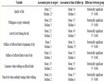
Then h-classes are {a, b} and {c, d} which are right zero “semigroup’s” and hence S is a semilattice of weakly cancellative “semigroup’s”, but S is not weakly balanced since ,
,  , but
, but .
.
The following is an example of quasi separative “semigroup”, which is not completely regular.
Example 13: Consider the “semigroup”  on which “.” is defined by

where . Clearly S is quasi separative “semigroup”, and since the inverse of (m, n) is (n, m) and
 , S is not completely regular.
Thorem 14: Let S be a separative “semigroup”, and  such that
  is a semilattice congruence then a Î
 .
.
Proof: Let S be a separative “semigroup” and a Î S such that E(a) is a semilattice congruence. Then for any ,
,  , so that
 . Now replace “y” by “b” and “x” by “a” then
  which implies
 . Since S is separative and
  we have
  so that
 . Since S is separative we have
 . Again since E(a) is a semilattice congruence,
  so that
  and hence
 .
.
Acknowledgements
We are very much thankful to the referees for their valuable suggestions.
Cite this paper
K. V. R.Srinivas, (2015) On Congruences Induced by Certain Relations on “Semigroups”. Advances in Pure Mathematics,05,579-582. doi: 10.4236/apm.2015.59054
References
- 1. Burmistrovich, I.E. (1965) Commutative Bands of Cancellative “Semigroup’s’”. Sib.Mat.Zh., 6, 284-299 (Russian).
- 2. Petritch, M. (1973) Introduction to “‘Semigroup’ Theory”. Merill Books, Columbus.
- 3. Krasilnikova, Yu.I. and Novikov, B.V. (2005) On Quasi-separative “semigroup’s”. “Semigroup” Forum, 70, 347-355.