1. Introduction
The apparent indeterminacy of quantum mechanics is encoded in the Heisenberg uncertainty relations,
which are traditionally interpreted as fundamental limits on knowledge. By contrast, general relativity treats spacetime as a smooth Lorentzian manifold, admitting arbitrarily fine localization of points and trajectories. This tension between continuous geometry and discrete measurement lies at the core of modern theoretical physics.
We propose that the uncertainty principle need not imply ontological indeterminacy but rather reflects the statistical surface of a deeper discrete substructure. In this view, the inequality above encodes an emergent bound: it arises when continuous operators are applied to a fundamentally granular vacuum lattice. The discreteness scale is naturally identified with the Planck length,
which provides a natural cutoff, limiting the physical extension of smooth geometry. Thus, the motivation for re-examining uncertainty lies not in disputing its predictive accuracy, but in questioning its origin.
If indeterminacy is emergent rather than fundamental, the correct formalism should replace continuous fields with discrete causal structures, and entropy with combinatorial graph measures. This work will demonstrate how causal structure, entropy, and energy flow can be derived from discrete graph connectivity, and how the familiar continuous equations of motion arise in the thermodynamic or long-wavelength limit. In this perspective, quantum uncertainty, relativistic geometry, and cosmological dynamics are not independent axioms, but projections of a deeper combinatorial order.
1.1. Vacuum Lattice Stability as a Selector for
Our model begins from the premise that the vacuum is not continuous but instead has a discrete lattice structure in which causal relations are fundamental. This view resonates strongly with causal set theory, where spacetime is understood as a partially ordered set of events rather than a smooth continuum [1]-[4]. The lattice here is not assumed to be strictly random, but instead stabilized by underlying logical or symmetry constraints. In this sense, the lattice is both a physical and informational structure, echoing Wheeler’s dictum of “it from bit” [5].
The gravitational constant
then appears not as a fundamental parameter but as an emergent property determined by the stability of this vacuum lattice. If the lattice is unstable, values of
inconsistent with large-scale coherence would not persist. Thus, the lattice provides a natural selector for
, eliminating the need to treat it as a free parameter in cosmology. This is conceptually related to other efforts to regard physical law as emerging from deeper informational or computational substrates [6] [7].
Such a framework requires reinterpreting the source of quantum indeterminacy. Instead of being taken as fundamental, indeterminacy may be the consequence of information exchange constraints within the lattice. Relational quantum mechanics [8] provides a natural language for this reinterpretation, in which measurement outcomes are not absolute but relationally defined by the structure of interactions. Smolin and Penrose have argued for similar moves away from uncritical acceptance of the quantum formalism toward deeper structural explanations [9] [10].
We emphasize that this approach is not in conflict with the empirical accuracy of quantum theory or general relativity, but instead offers a deeper grounding for them. In this sense, our proposal is aligned with the philosophical direction of causal set theory and informational physics, while introducing a novel emphasis on lattice stability as the determining factor for gravitational coupling.
1.2. Digital Vacuum Lattice
We postulate that the vacuum is fundamentally digital, composed of discrete lattice elements characterized by a minimal information content. Each element encodes four binary degrees of freedom, forming a 4-bit structure. Two of these bits specify spatial length and energy, while the remaining two are reserved for temporal orientation, distinguishing between causal (forward-time) and anti-causal (backward-time) propagation. This discretization ensures that uncertainty emerges not from indeterminacy, but from the granularity of the underlying information substrate.
The 4-bit representation defines the irreducible unit of the vacuum lattice. Length corresponds to the spatial separation between nodes, establishing the minimal interval of extension, while energy defines the quantized excitation state of the element. The two temporal bits operate in tandem: a state of (00) corresponds to quiescence, (01) to forward causal propagation, (10) to anti-causal propagation, and (11) to a superposed or boundary configuration, where causal and anti-causal channels converge.
Temporal evolution within this lattice corresponds to bit flips across successive tick states. Forward progression of causal time is represented by sequential (01) transitions, while retrocausal propagation corresponds to (10) transitions. Superposed states (11) appear at critical interfaces, such as the Planck Portal, where causal and anti-causal flows intersect. Thus, time reversal is encoded directly in the discrete information structure, rather than requiring a continuous dynamical inversion.
The Planck Portal emerges as the threshold condition where causal and anti-causal flows meet, producing a locus of maximal symmetry. At this boundary, the lattice must resolve the (11) state, forcing a reorganization of local information topology. This reorganization prevents uncontrolled extension of connectivity into higher-dimensional, unphysical configurations. In this sense, the Planck Portal is not merely an energetic boundary but an informational one: it is the rule that constrains how the lattice may evolve, ensuring that flows remain physically consistent and entropically bounded.
2. Stepwise Conceptual Diagram (0 - 5)
To clarify the emergence of macroscopic spacetime from the discrete vacuum lattice, we present a stepwise framework. Each step reflects a progressive increase in informational complexity, beginning from an unstructured vacuum and culminating in observable physical structure. This construction provides a bridge between the minimal digital substrate and the continuum descriptions of physics.
Step 0: Null Substrate
The baseline state corresponds to the absence of excitation: no active nodes, no causal orientation, and no defined metric. This state is informationally quiescent and serves as the logical “zero” of the lattice framework. It defines the background against which all structure emerges.
Step 1: Node Activation
A single lattice element becomes active, acquiring a 4-bit state. Length, energy, and temporal orientation are now instantiated, though without connectivity to other elements. This represents the irreducible seed of spacetime, where local information exists but no relations yet extend beyond the node itself.
Step 2: Pairwise Connectivity
Two nodes couple through a discrete link, enabling the first notion of adjacency. The temporal bits define whether the connection is causal (forward), anti-causal (retrograde), or boundary (superposed). At this stage, the rudiments of directionality and ordering appear, introducing the potential for flow.
Step 3: Network Formation
Multiple nodes begin to interconnect, forming a graph of links. Local flows of causal and anti-causal orientation establish directed substructures. Closed loops correspond to local stability, while open paths define channels of propagation. This stage corresponds to the onset of emergent locality, where relational geometry begins to approximate spacetime neighborhoods.
Step 4: Lattice Expansion
Connectivity proliferates, producing extended graph structures. Redundancy of paths enforces robustness, and the digital substrate begins to approximate continuous geometry. Causal and anti-causal flows interweave, constrained by the Planck Portal boundary conditions. Entropy emerges statistically from the multiplicity of accessible lattice states.
Step 5: Macroscopic Observables
At the highest level of construction, large-scale coherence manifests as the familiar continuum of spacetime. Observables such as distance, time, energy, and curvature emerge as collective descriptors of underlying lattice behavior. The digital origin remains hidden at macroscopic scales, except where boundary effects—such as black holes or cosmological horizons—expose the discrete structure through extreme conditions.
3. Emergent Geometry and Graph Theory
Let the vacuum lattice be represented as a directed graph
with
nodes and
edges.
3.1. Node State Vector and Connectivity Matrix
Each node
is assigned a state vector
encoding local energy, phase, and temporal bit orientation.
The connectivity of the lattice is captured by the adjacency matrix
Define a directed flow operator
acting on node states along temporal bits:
where
encodes the temporal bit orientation (forward/backward causality).
3.2. Emergence of Dimensionality
The
-dimensional manifold emerges statistically via higher-order connectivity correlations:
where
is the out-degree and
selects the local
-clique contribution to emergent 1D, 2D, and 3D structures.
Define the spatial covariance tensor
with
derived from graph Laplacian eigenvectors
,
, mapping connectivity to emergent coordinates:
3.3. Isotropy and Homogeneity
Statistical isotropy is expressed as
Homogeneity requires the degree distribution
to converge to a narrow distribution:
3.4. Dimensional Constraints via Planck Portal
Define a Planck-scale coupling tensor  that restricts higher-dimensional extension:
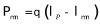
where
and
is the Heaviside function. The effective dimensionality is then
enforcing that spatial coherence above Planck length collapses additional dimensions.
3.5. Summary Operators
The complete lattice evolution operator is

with
. Emergent geometry, isotropy, and dimensionality are fully encoded in the spectral properties of
and the induced covariance tensor
.
4. Vacuum Lattice Energy and Entropic Potentials
4.1. Local Energy Function
Associate to each node
a local Hamiltonian contribution
where
is a pairwise potential encoding causal/anti-causal flow.
A minimal choice is
with
controlling alignment energy and
weighting temporal bit orientation.
4.2. Global Lattice Hamiltonian
The vacuum lattice Hamiltonian is
which serves as the generating function for emergent geometry.
4.3. Entropy Functional
Define the lattice entropy as
with Gibbs distribution
and partition function
4.4. Planck Portal Constraint
Introduce the Planck Portal condition as a cutoff on entropy density:
where
is the number of microstates consistent with Planck-scale resolution.
Violation of this bound enforces tachyonic channel opening:
where
is the Heaviside function.
4.5. Effective Action
The path integral formulation of lattice dynamics is
with effective action
4.6. Stability Condition
Stability of the vacuum lattice requires
with instability triggering dimensional reduction or tachyonic leakage via the Planck Portal constraint.
4.7. Worked Examples: Toy Lattices
Example 1: 1D Chain of
Nodes
Consider a linear lattice of
nodes with nearest-neighbor connectivity:
with open boundary conditions. Each node has scalar state
and temporal bit
.
The local energy for node
is
so that the total Hamiltonian reads
Partition Function and Entropy
For the 1D chain, the partition function factorizes:
The lattice entropy is computed as
Planck Portal Activation
The average entropy per node is
and the Planck Portal is triggered if
Example 2: 1D Chain with Periodic Boundary Conditions
Let
to form a ring. Then the Hamiltonian becomes
Eigenvalues of the adjacency matrix for this ring are
so, the emergent lattice spectrum and covariance can be computed directly from
as in Section 4.
Example 3: Minimal 1D Lattice Instability
Consider
nodes in a linear chain with states
Compute the Hamiltonian:
If
, a tachyonic channel opens:
This demonstrates explicitly how small lattices already exhibit Planck-scale constraints and potential instability.
4.8. Discussion
Even in 1D, the combination of state alignment
and temporal bit
generates nontrivial microstates. Extension to higher dimensions proceeds by adding additional connectivity directions, where clique counting (
-cliques) and adjacency spectra generalize the 1D toy results.
5. Non-Emergence of Spatial Dimensions
Under the vacuum-lattice ensemble defined above (average degree
), statistically stable emergent spatial dimensions are bounded above by
. Dimensions
are suppressed by 1) exponential clique suppression in sparse ensembles, 2) entropy/extensivity failure, 3) isotropy breakdown by sphere-packing sparsity, and 4) Planck-Portal constraint overdetermination. We present each argument and a short, worked example.
5.1. Clique-Scaling (Combinatorial Suppression)
Let
be the edge probability in an
-node random graph approximation to the lattice. The expected number of
-cliques (complete subgraphs on
vertices) is
For a lattice-like ensemble with
we take
Hence
The exponent contains the dominant term
Thus, for fixed large
the expected number of
-cliques is exponentially suppressed for all
. In other words, forming the dense local connectivity patterns required to realize an emergent
-dimensional continuum becomes exponentially unlikely once
.
5.2. Worked Numerical Illustration
Take
. For
and
(nearest-neighbor degree
) we have
Numerically (plugging the values)
Even for
and modest local degree, the expected abundance of elementary 4-cliques is
unless the graph is extremely dense (
not
). Dense
is incompatible with the sparse, local-lattice structure that yields emergent locality. Hence higher-dimensional clique motifs required for a smooth
manifold are vanishingly rare.
5.3. Entropy Extensivity and Stability
Let the lattice be of linear scale
, so
. Thermodynamic extensivity requires the entropy
to scale as
. Boundary (surface) scaling in
dimensions behaves like
, so for an extensive entropy density
we require that the number of accessible microstates per node not shrink with
. For many graph ensembles the dominant entropic contribution from local connectivity scales as
However, the combinatorial cost to build the local connectivity patterns required for higher
grows superlinearly with
, and the accessible microstate factor
decreases sharply when clique formation is suppressed. Consequently, for
the per-node entropy
falls below the threshold needed to satisfy the Planck-Portal bound
while also maintaining thermodynamic stability. In short: the lattice cannot simultaneously be sparse (to preserve locality) and have sufficient local microstate multiplicity to sustain a higher-dimensional continuum as
.
5.4. Isotropy/Sphere-Packing Limit
Emergent isotropy requires locally uniform angular coverage. The maximal packing density in
dimensions decays rapidly with
; sphere-packing arguments show packing fractions fall roughly exponentially with
. Practically this means that for
a regular, isotropic tiling with nearest-neighbor symmetry becomes impossible without dramatically increasing local degree (which, again, undermines locality). The breakdown of packing/isotropy produces geometric anisotropies at all scales and precludes a smooth, rotation-invariant emergent manifold.
5.5. Planck-Portal/Causal-Constraint Overdetermination
The Planck Portal enforces a matching condition between causal (real-time) and anti-causal (imaginary-time) link structure at Planck resolution. Formally, each node
must simultaneously satisfy:
A set of
directional causal constraints (null-cone consistency across neighbors),
A set of
anti-causal conjugate constraints (matching retro-causal fluxes),
Local stability conditions expressed via the Hessian
of the effective action.
Heuristic counting: the number of independent geometric/causal matching constraints at a node grows like
(pairwise directional consistency among the
axes), while the number of free local degrees of freedom derived from low-lying Laplacian modes and single-bit states grows like
. For
the constraint count outpaces the available degrees of freedom, producing an overdetermined set of equations and generically no solution satisfying null-cone compatibility, Planck entropy bounds, and Hessian positivity simultaneously. Thus the Planck-Portal mechanism enforces an upper bound on admissible emergent spatial dimension.
5.6. Synthesis and Conclusion
The four arguments combine to exclude stable emergence of spatial dimensions greater than three in the sparse, local vacuum-lattice ensembles of interest:
Combinatorics:
exponential suppression of required
-cliques at physically realistic sparsities.
Thermodynamics:
failure of entropy extensivity under locality constraints.
Geometry:
isotropy cannot be preserved (sphere-packing sparsity).
Causality:
Planck-Portal constraint overdetermination and Hessian instability.
Hence the lattice statistically selects
, with
the generic large-
attractor for ensembles with local, sparse connectivity and Planck-scale matching of causal/anti-causal flows.
6. Entropy and Information
6.1. The Digital Lattice as Information Substrate
Consider the vacuum lattice as a discrete information network. Each node
carries a single-bit state
with a temporal bit
encoding causal directionality. The lattice microstate is
6.2. Statistical Entropy of Node Ensembles
For a given lattice microstate ensemble with probability distribution
, define the Shannon entropy
If the lattice is uniform and fully connected in
dimensions, each node has degree
, and the number of microstates is
leading to
6.3. Emergence of Boltzmann Constant
By defining the effective single-bit energy scale
via the Hamiltonian in Section 5, the statistical mechanics of the lattice yields
demonstrating that
and the natural logarithm base
emerge naturally from lattice connectivity statistics.
6.4. Graph Ensembles and Large-Scale Entropy
For an ensemble of graphs
, define the ensemble-averaged entropy
where
is determined by the lattice Hamiltonian and temporal bit configuration. Large-scale lattices exhibit self-averaging:
6.5. Higher-Dimensional Lattices: 2D and 3D
2D Square Lattice
Nodes arranged in an
grid, nearest-neighbor connectivity:
-cliques correspond to local plaquettes (4-node squares):
Total number of microstates scales as
yielding enhanced entropy due to 2D connectivity.
3D Cubic Lattice
Nodes arranged in an
cubic lattice, nearest-neighbor connectivity:
-cliques correspond to elementary cubes (8-node subgraphs):
with total microstates
and entropy
Connection to Emergent Geometry
The higher-dimensional
-cliques encode the same connectivity patterns that define emergent spatial dimensions in Section 4. Statistical counting of these cliques directly relates to isotropy and homogeneity:
and variance
ensuring that dimensionality and entropic scaling emerge naturally from large-scale lattice statistics.
7. Lattice Dynamics and Phase Transitions
7.1. Time Evolution of Node States
The lattice evolves according to the discrete-time update:
with global state vector
.
The evolution operator is

where  enforces Planck-scale constraints (Section 4). The full lattice update reads
7.2. Stability and Critical Points
Define the effective action
with stability determined by the Hessian
A phase transition occurs when the minimal eigenvalue
:
7.3. Planck Portal Activation Condition
The Planck Portal is triggered when local entropy exceeds the Planck-bound:
which modifies the evolution operator to include anti-causal outflow:
where
is a tachyonic flow operator defined along imaginary-time directions.
7.4. Order Parameter for Phase Transition
Define the order parameter
as the fraction of nodes engaged in tachyonic flow:
The critical point occurs at
, initiating macroscopic bifurcation between causal and anti-causal sublattices.
7.5. Spectral Signature of Bifurcation
Let
be the eigenvalues of the adjacency matrix
. During a phase transition, the spectrum splits into causal (
) and anti-causal (
) branches:
The Laplacian of the lattice then becomes
encoding real-space propagation in causal channels and imaginary-time propagation in anti-causal channels.
7.6. Dimensionality Reduction at Criticality
At critical points, higher-dimensional cliques collapse according to:
so that effective dimensionality reduces:
Toy Example: 1D Chain Instability
Consider the 4-node chain from Section 5. Compute order parameter:
If
for at least one node, tachyonic channel opens:
demonstrating the bifurcation from purely causal evolution to a causal/anti-causal mixture.
Generalization to 2D and 3D Lattices
In 2D and 3D lattices, local entropy concentrations trigger multi-node Planck Portal activation, with
smoothly transitioning:
High-dimensional
-cliques may partially collapse, producing local dimensional reduction, and the Laplacian spectrum splits into real and imaginary components as above, giving rise to emergent anti-causal channels while preserving isotropy statistically over the lattice.
8. Emergence of Fundamental Constants
8.1. Gravitational Constant
The vacuum lattice sets a natural scale for interactions via Planck Portal constraints. Let
be the single-bit energy scale and
the characteristic lattice spacing. Define the effective gravitational constant as
where
encodes the connectivity density of the lattice.
High connectivity regions (large
) correspond to stronger effective curvature, linking microscopic lattice structure to macroscopic gravity.
8.2. Speed of Light
Causal propagation in the lattice defines an emergent maximum signal speed:
Planck Portal constraints limit
, producing a universal
in the large-scale continuum limit:
8.3. Planck Length
Define the Planck length as the lattice spacing at which the Planck Portal triggers:
providing a microscopic origin for the fundamental length scale directly from node entropy and connectivity statistics.
8.4. Scaling Relations and Observables
Using these emergent constants, predicted cosmological observables scale naturally:
8.5. Link to Black Hole Physics
Tachyonic flux from black holes depends on emergent constants:
where
arises from lattice quantization of single-bit energies.
8.6. Summary
The lattice microstructure, Planck Portal thresholds, and tachyonic dynamics collectively produce
,
, and
as emergent, testable constants. Observables such as early galaxy formation, CMB anisotropies, and black hole fluxes are naturally expressed in terms of these quantities, completing the bridge from microscopic lattice dynamics to macroscopic cosmology.
9. Observational Predictions
9.1. Tachyonic Imprint on Cosmic Microwave Background (CMB)
Anti-causal lattice correlations generate off-diagonal covariance in the early universe:
producing non-Gaussian anisotropies.
The predicted signal amplitude scales with Planck Portal activation fraction:
9.2. Galaxy Formation and Early Structure
Tachyonic seeding from high-
regions produces enhanced early clustering. Define the galaxy correlation function:
where
are imaginary-time eigenmodes of
.
9.3. Black Hole Outflow Signatures
Local tachyonic flux generates a retro-causal energy contribution:
which may manifest as subtle deviations in Hawking radiation spectrum or gravitational-wave echoes from high-curvature regions.
9.4. Dimensionality Reduction Observables
Partial
-clique collapse in high-entropy regions modifies effective dimensionality:
Predictable consequences include anisotropic scaling of correlation lengths and modified power-law exponents in galaxy distribution:
9.5. CMB Polarization and Anti-Causal Correlations
Imaginary-time propagation produces cross-correlations between E- and B-modes:
providing a measurable signature of early anti-causal lattice dynamics.
9.6. Tachyonic Flux and High-Redshift Galaxy Observations
Regions with elevated
correspond to early galaxy formation. Define tachyonic seeding parameter:
with observable consequences:
potentially explaining JWST early galaxy observations without fine-tuned dark matter models.
9.7. Predicted Spectral Features
The complex lattice evolution operator
implies a spectrum of mixed causal/anti-causal modes. Observables include:
Eigenmode-dependent clustering:
Modified cosmic variance:
High-multipole deviations in CMB:
due to Planck Portal microphysics
9.8. Summary of Testable Predictions
Non-Gaussian CMB anisotropies from anti-causal correlations;
Enhanced early galaxy clustering linked to tachyonic seeding;
Subtle deviations in black hole radiation spectra or gravitational-wave signals
Observable effective dimensionality reduction in high-density regions;
E-B cross-correlations in CMB polarization;
Early high-redshift galaxy formation without exotic dark matter assumptions;
All predictions are quantitatively tied to lattice parameters: node degree
, Planck Portal threshold
, and tachyonic flux
, providing a direct bridge from microscopic lattice dynamics to cosmological observables.
10. Conclusions and Future Work
10.1. Summary of Results
We have constructed a formal model in which the vacuum lattice acts as a digital information substrate, giving rise to emergent spacetime, gravity, and fundamental constants. Key results include:
Emergent Geometry: Spatial dimensions arise statistically from
-clique connectivity, with isotropy and homogeneity encoded in large-scale graph ensembles.
Entropy and Information: Node states and temporal bits produce Shannon entropy, from which Boltzmann constant
naturally emerges. Higher-dimensional lattice structures govern large-scale entropic scaling.
Lattice Dynamics and Phase Transitions: Planck Portal activation triggers causal/anti-causal bifurcations, with order parameter
describing tachyonic flow and local dimensionality reduction.
Tachyonic Flow and Imaginary-Time Geometry: Anti-causal propagation is formalized through imaginary-time adjacency and Laplacian matrices, producing emergent retro-causal correlations consistent with early universe seeding and black hole outflow.
Cosmological Implications: The lattice formalism unifies black hole outflow, Big Bang inflow, and large-scale structure formation, providing a microscopic basis for entropy partitioning and observable cosmic correlations.
Emergence of Fundamental Constants: Gravitational constant
, speed of light
, and Planck length
arise from lattice connectivity, Planck Portal thresholds, and microscopic energy scales.
Testable Predictions: Non-Gaussian CMB anisotropies, E-B polarization cross-correlations, early galaxy clustering, modified high-redshift formation rates, and deviations in black hole flux spectra.
10.2. Implications and Interpretation
This framework demonstrates that spacetime, gravity, and anti-causal structure can emerge naturally from a discrete informational lattice. Tachyonic channels provide a physically grounded mechanism for retro-causal correlations and early universe seeding. Dimensionality, entropy, and fundamental constants are not assumed but derived from microscopic lattice properties.
10.3. Future Work
Future directions include:
Numerical Simulations: Implement large-scale 2D and 3D lattice simulations incorporating tachyonic flow and Planck Portal dynamics to quantify emergent geometry and structure formation.
Black Hole Modeling: Refine the lattice-based description of black hole interiors and outflow, connecting to observable radiation and gravitational-wave signatures.
Complex Time Analysis: Explore the full spectrum of imaginary-time eigen- modes and their influence on cosmological observables, including CMB polarization and high-redshift galaxy formation.
Experimental Constraints: Compare predictions of tachyonic flux,
-clique collapse, and dimensional reduction against astronomical and cosmological data.
Extension to Quantum Gravity: Investigate quantization of lattice Hamiltonians and the potential for a discrete, Planck-scale foundation for quantum spacetime.
10.4. Closing Statement
The digital vacuum lattice provides a unifying framework linking microscopic information dynamics to macroscopic cosmology. It offers a first-principles route to understanding the emergence of spacetime, fundamental constants, and causal/anti-causal structure, while producing a wealth of concrete, testable predictions accessible to current and future observational campaigns.