

Advances in Pure Mathematics
Vol.10 No.04(2020), Article ID:99826,19 pages
10.4236/apm.2020.104012
The Extension of Cauchy Integral Formula to the Boundaries of Fundamental Domains
Dorin Ghisa
Glendon College, York University, Toronto, Canada

Copyright © 2020 by author(s) and Scientific Research Publishing Inc.
This work is licensed under the Creative Commons Attribution International License (CC BY 4.0).
http://creativecommons.org/licenses/by/4.0/



Received: March 1, 2020; Accepted: April 24, 2020; Published: April 27, 2020
ABSTRACT
The Cauchy integral formula expresses the value of a function , which is analytic in a simply connected domain D, at any point interior to a simple closed contour C situated in D in terms of the values of on C. We deal in this paper with the question whether C can be the boundary of a fundamental domain of . At the first look the answer appears to be negative since contains singular points of the function and it can be unbounded. However, the extension of Cauchy integral formula to some of these unbounded curves, respectively arcs ending in singular points of is possible due to the fact that they can be obtained at the limit as of some bounded curves contained in the pre-image of the circle and of some circles for which the formula is valid.
Keywords:
Fundamental Domain, Dirichlet Functions, Modular Function, Weierstrass Function

1. Introduction
We make reference to [1] for elementary knowledge in complex analysis used below. It is known (see [2]) that for every rational function of degree n the complex plane can be partitioned into n sets whose interior are fundamental domains of , i.e. they are mapped conformally (hence bijectively) by onto the whole complex plane with some slits. A similar partition takes place for transcendental functions (see [3]), except that for those functions the number of fundamental domains is infinite. Every fundamental domain of an analytic function is either unbounded or contains singular points of , or both.
Although integrals on unbounded contours have been used frequently in complex analysis (see [1], page 214), they have never appeared in the context of Cauchy integral formula. The main novelty of this paper is that it makes possible such an undertaking. The famous Cauchy integral formula is in this way upgraded from a rather local instrument to a more global one. Moreover, it shows that the functions we are studying are completely determined by the values on the boundaries of their fundamental domains.
The integral on of shall be treated as an improper integral the convergence of what remains to be investigated. This can be accomplished in different ways which apply to particular classes of functions; hence instead of trying to prove theorems valid for any analytic function, we must treat separately those classes of functions. However, the techniques used are in general similar; namely they consist in isolating the singular points and by the pre-image of some circles whose radii are let tend to zero, respectively to infinity, then in applying the Cauchy integral formula to the bounded sub-domains of obtained in this way and making sure that the integrals on the boundaries of the complementary domains tend to zero when the radii tend to zero or to infinity. As is injective in every fundamental domain, if such a domain is mapped conformally by the function onto the complex plane with a slit; then for some values there is a function corresponding to that fundamental domain such that ,. The function is injective in the interval and maps this interval onto an arc included in that fundamental domain. Making the change of variable in the integral it becomes an integral on the interval and it is possible that it tends to zero as or . This assertion should be checked for every particular class of functions.
The contours we used for integration needed to be illustrated and most of the graphics are computer generated by the software Mathematica. When this was not possible, we used illustration by hand made drawings. However, they are pictures of known fundamental domains (see [1], page 268 and 282). One of the most studied classes of meromorphic functions is that of Dirichlet functions and it can be considered as a prototype in many aspects. Let us start then with this class.
2. General Properties of Dirichlet Functions
The Dirichlet functions are obtained by analytic continuation of general Dirichlet series across the line of convergence. The family of general Dirichlet series includes that of well known Dirichlet L-series defined by Dirichlet characters. These last series can be all extended as meromorphic functions in the whole complex plane. The extended functions are called Dirichlet L-functions. They are implemented in Mathematica and some affirmations about general Dirichlet functions are illustrated by using Dirichlet L-functions. However, the interest in more general functions is obvious and we have recently devoted to them a lot of publications (see [2] - [15]). An account of recent advances in this field can be found in [8].
A general Dirichlet series is defined by an arbitrary sequence of complex numbers , the coefficients of the series and by a non decreasing sequence of non negative numbers , the exponents of the series. It is given by the formula
(1)
We will deal only with normalized general Dirichlet series in which and . For such a series we have uniformly with respect to t (see [8], Theorem 3). There is a number , called the abscissa of convergence of , such that the series (1) converges for and it diverges for . The series converges uniformly on compact subsets of and therefore it is an analytic function in that half plane. Denoting by we have proved in [8] that if the abscissa of convergence of is finite then the abscissa of convergence of is zero and if has only isolated singular points on , then can be continued across the line to a meromorphic function in the whole complex plane. We keep the notation for the extended function when it exists and we call it Dirichlet function. Following Speiser [16], who studied the Riemann Zeta function, we have used in [2] - [15] the pre-image of the real axis by . This is the set of points in the s-plane where takes real values. For every Dirichlet function it is a family of analytic curves whose structure has very profound implications on the value distribution of that function. Figure 1(a) illustrates the pre-image of the real axis by a Dirichlet L-function defined by a complex Dirichlet character and Figure 1(b) by a real one. Details about Figure 1(c) are found in Section 3.
We have proved (see for example [8]) that for any Dirichlet function this pre-image is formed with unbounded curves (components) which fall into three categories. Namely, there are infinitely many curves , which do not intersect each other and consecutive and ( below ) form infinite strips extending for going from to . The counting is such that . Every curve is mapped homeomorphycally by onto the interval of the real axis and therefore every -strip is mapped (not necessarily one to one) onto the whole complex plane with a slit alongside this interval. For every strip contains a unique component of the pre-image of the real axis which is mapped homeomorphycally by onto the interval of the real axis and a finite number of components which are mapped each one homeomorphycally by onto the whole real axis. The component

Figure 1. The pre-image of the real axis by Dirichlet L-functions.
extends for going from to , while are parabola shaped curves with a finite supremum of , therefore we can distinguish the interior and the exterior of such a curve.
In the case of a strip , if then connecting with by a Jordan arc the component of the pre-image of passing through can be an unbounded curve , when for we have . On the other hand the origin of such a curve must be a point on a curve such that . The curve is bounded when its ends belong to different curves and . This is the case when and are embraced curves (see [8]) and when . The curve is mapped 2 to 1 by onto . Then we can form fundamental domains using parts of the curves , the curves (and , when is the case, as in Figure 2). These are strips unbounded to the right and to the left when is unbounded and they are bounded to the right when is bounded. They are mapped conformally by onto the whole complex plane with some slits alongside the interval of real axis and some other slits alongside .
In the case of the strip , when the zeros of are complex, the curves are all bounded for and together with they form the

Figure 2. Conformal mapping of fundamental domains by .
boundaries of fundamental domains bounded to the right. It is known (see, for example [13]) that every -strip, of can be partitioned into a finite number of sets whose interior are fundamental domains of . The -strip contains infinitely many fundamental domains. The way they are mapped conformally onto the complex plane with some slits by the Riemann Zeta function is illustrated in Figure 2 (see [13], Figure 6).
3. Cauchy Integral Formula for Fundamental Domains and Sk-Strips of the Function
The Cauchy integral formula has the form:
(2)
where the function is analytic in a simply connected domain D containing the simple closed contour C and is an arbitrary point inside C.
We would like to be a Dirichlet function and C to be the boundary of a fundamental domain of or the boundary of an -strip. The problem is that and are not simple closed contours. However, we can show that the formula (2) can be extended to these curves.
The shape of the fundamental domains of depends on the pre-image of the real axis and on the zeros of . Since is injective in every fundamental domain the zeros of must be located on the boundaries of these domains. Figure 3 portrays a fundamental domain of bounded by a curve , the part of the last curve from on which vary from to , where we have , as well as the pre-image of the segment determined by and where is the zero of the closest to . The pre-image of the circle and the pre-image of the circle are also drawn, where r is big enough and is small enough. Figure 1(c) illustrates computer generated pre-images of these circles for (the orange curve)

Figure 3. A fundamental domain of and its conformal mapping.
and (the green curve). It has been worked by Florin Alan Muscutar. Due to the continuity of at and to the fact that is a normalized Dirichlet series, the arc squeezes to the point and with s on tends to as . Also with s on tends to as .
The domain is mapped conformally by onto the complex plane with a slit alongside the subinterval of the real axis and alongside the segment determined by and . Also, the domain is mapped conformally onto the ring domain determined by the two circles with the corresponding slit (see Figure 3). The function is analytic in a domain containing and therefore the Cauchy integral formula is valid for .
Theorem 1. If we denote by the infinite strip obtained from as , then for every we have
(3)
Proof: Let us take
. Then the pre-image of the circle
intersected with
is formed with two arcs
inside
and
at the right of
. The arcs
and the curves
and
determine a curvilinear quadrilateral whose conformal module is the same as that of the quadrilateral determined by
, the real axis and the segment from
to
, which in turn is less than the conformal module of the ring domain
. It is known (see [17], page 31) that the value of this last module is
. If we take
then this module is
, which shows that the length of
remains bounded as
, since otherwise the respective module would tend to
, contrary to the fact that it remains constant . Let us evaluate
 . Since
  we have that
 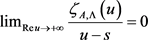 and since the length of
  remains bounded we have
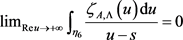 .
.
On the other hand, by Cauchy theorem 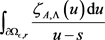 does not depend on
  since
since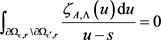 . Then we can let
  in
in  and we obtain (3).
It is not clear what happens with  as
as . Making the change of variable
 , where
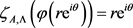 , which is allowed since
  is injective on
 , we get
 .
.
Although the integrand tends to zero as , a limitation of the initial integral is problematic, due to the factor
  in the last term. So, as long as we cannot make sure that
  tends to zero as
 , the problem of extending the Cauchy integral formula to the whole fundamental domain remains unsolved.
Theorem 2. Let  be an arbitrary strip of the function
  as defined in Section 2 and for r big enough let
  be the part of the pre-image by
  of the circle
  included in
 . We denote by
  the part of the strip
  bounded at the left by
 . Then for every
  we have:
 (4)
(4)
Proof: For an arbitrary  and for the given r, let us build the domains
  as in Theorem 1 corresponding to every fundamental domain
 . The sum of the corresponding arcs
  from these domains is
  and the sum of the corresponding arcs
  is an arc
  connecting
  and
and . The arcs
  squeeze each one to the respective points
  when
when , where
 .
.
Since for each arc  we have
  it results that
 . Denoting by
  the domain bounded by
  and the arcs
  we see that this domain becomes
  when
when . On the other hand, the Cauchy integral formula is applicable to
 , i.e. for every
  we have
  and then at the limit as
  this equality becomes (4) and the theorem is proved.
We notice that this theorem says that the values of  are completely determined by its values greater than 1 and those taken on an arbitrary circle of radius big enough. Moreover, the integral of the formula (4) is always convergent.
If  is the parametric equation of
  such that
  then the formula (4) becomes
 (5)
(5)
We notice that , hence the first integral in (5) is an improper integral. By Theorem 1 this integral is always convergent.
The function  is not injective in
 , hence the integrals (4) and (5) give us the same value for different points s in
 . If we would like to have a unique point corresponding to a given value, then we need to use the formula (3).
Also, taking into account the fact that the domain interior to every curve , which is not embracing curve, is mapped conformally and therefore injectively by
  onto the upper or the lower half plane, a unique point s from that domain corresponds to every given value from the respective half plane. Then the following formula is true for every r big enough:
 (6)
(6)
where  is the boundary of the domain bounded by
  and the pre-image of the circle
 .
.
If the equation of the curve  is
is  such that
  then the formula (6) becomes
 (7)
(7)
where .
.
4. The Distribution of the Values of a Dirichlet Function
The contour of integration in Theorem 2 is simpler than that appearing in Theorem 1. However, (3) has the advantage of representing a univalent function in . The pre-image of the circle
  intersects several components of the pre-image of the interval
  of the real axis situated in
 , more exactly if
  has m zeros in
 , then this pre-image intersects exactly
  such components, hence it traverses m fundamental domains. Each one of these domains contains a unique point
  such that
 . A point on the circle
  should turn m times around the origin for its pre-image to traverse the m fundamental domains going from
  to
to . At every turn it assigns a unique point
  where
where  takes the same value. Since
  is univalent in
  that value is completely determined by the values on
  and
and .
.
5. Extension of Cauchy Integral Formula for the Derivatives of Dirichlet Functions
Following the known technique of computing 
we find that
 (8)
(8)
Thus, as for  the values of
  are completely determined in every strip
  by the real values greater than 1 of
 . By recursive computation we find that:
 (9)
(9)
for every natural number n.
It is known (see [4] and Figure 4) that if a Dirichlet L-function  has m zeros in the strip
  then
then  has
has  zeros in
  (which are all simple zeros).
This figure illustrates the following:
Theorem 3. If  has m fundamental domains in
  then every derivative
  has exactly
  zeros in
 .
.
Proof: The pre-image by  of a circle
  has m components in
  which are disjoint if r is small enough. By letting r increase these components expand and after two of them touch each other, they fuse into a unique component including the corresponding zeros. When
  a unique component becomes unbounded with branches tending to
  with
with . The remaining bounded components are outside this unbounded one and none of them can intersect
 . Increasing r past 1 the unbounded components from all the strips
  fuse into a unique unbounded component crossing these strips. After touching bounded components of the pre-image of the circle
  with
with  (if such components exist in a given
 ), these last components are absorbed into the unbounded one and the corresponding zeros of
  pass
pass

Figure 4. The zeros of  and those of its first two derivatives for
 .
.
to the right of it. For r big enough all the zeros of  from the strip
  will be at the right of the unbounded component of the pre-image of the circle
 . That value of r depends on
 .
.
The points where two components of the pre-image of a circle  touch each other are the zeros of
 . A complete binary tree can be formed having as leaves the zeros of
  and as internal nodes these touching points. It is known from the graph theory that if a complete binary tree has m leaves then it has exactly
  internal nodes. This proves that
  has
has  zeros in
 . The zeros of the second derivative are obtained in a similar way, yet since
 , there will be m components of the pre-image by
  of the circle
  for r small enough, even if there are only
  zeros of
 . One of these components contains no such a zero. These components touch each other at the zeros of
  and by the previous analysis there should be
  zeros of
 . The same procedure can be applied to derivatives of any higher order and the theorem is completely proved.
Figure 5 portraying the pre-image of the real axis by the Riemann Zeta function and by its derivative shows that their  -strips and their fundamental domains overlap, but they do not completely coincide (see [11]). However, the

Figure 5. The pre-image of the real axis by  and
and .
.
integral (8) gives the same value for  as
as
 (10)
(10)
since if  is the corresponding strip of
  the integral on
  is zero, by Cauchy Theorem. The same is true for the integrals on the boundaries of the corresponding fundamental domains of the two functions.
6. Extension of Cauchy Integral Formula to Fundamental Domains of Modular Function
By the Riemann mapping theorem there is a unique analytic function  mapping conformally the domain D bounded by the half lines
 ,
,  ,
,  and the half circle
  onto the upper half plane
  such that
 ,
,  and
and . The function
  can be continued by symmetry into the upper half plane as in Figure 6.
The symmetric domain  of D with respect to the imaginary axis is mapped conformally by
  onto the lower half plane and
  is mapped conformally onto the whole complex plane with the slit
 , alongside the real axis, hence
  is a fundamental domain of
 . In fact the union any two adjacent domains bounded by the half circles above (the half lines can be considered half circles too!) and the common half circle is a fundamental domain of
 . For example
  is mapped conformally by
  onto the whole complex plane with the slit
  and
and  is mapped conformally by
  onto the

Figure 6. Continuation by symmetry of the modular function.
whole complex plane with the slit  etc. So, Figure 6 exhibits a partition of the upper half plane into fundamental domains of
 . Each one of these half circles ends up into a singular point of
 , therefore these singular points form a dense subset of the real axis, which implies that
  cannot be continued across the real axis and its full domain of definition is the upper half plane.
The way the function  has been constructed implies that for every s in the upper half plane we have
  and
and  and then (see [1], page 280)
  uniformly with respect to
 . Hence the part of the pre-image by
  of the circle
  included in
  is an arc
 :
: ,
,  , where
  uniformly with respect to
 . In particular, denoting by
  the inverse of
  in
in , we have
  as
as .
.
On the other hand, the part of the pre-image by  of the circle
  included in
  is formed for r big enough with two arcs
  and
and  such that for
  we have
  as
as  and for
  we have
  as
as . Let us denote by
  the part of
  obtained by removing the pre-image of the set
 .
.
Theorem 4. For any fundamental domain  of the function
  and any point
  we have:
 (11)
(11)
Proof: Let us deal first with the fundamental domain
 . By isolating the point
  with a small circle
  and the point
  with a big circle
  and by removing from
  the pre-image of the disc
  and of the exterior of the disc
  we obtain a bounded domain
  for which the Cauchy integral formula is applicable: for any
  we have
 . Taking
  and having in view the Cauchy theorem we conclude that
  and since
 , we can set
  and get (11).
Now, if we take for example  and proceed similarly, the new
  is the part of the pre-image of the circle
  included in D, hence again.
 and the extension of the Cauchy integral formula is true for the new unbounded domain
 . We are brought to the same conclusion when
 .
.
This theorem tells us that the modular function is completely determined by its real values and by the values on the pre-image of an arbitrary big circle centered at the origin.
7. Extension of Cauchy Integral Formula to the Fundamental Domains of the Exponential Function
It is known that the horizontal strips bounded by consecutive lines  are fundamental domains
  of the exponential function
 . The function
  maps conformally each one of these strips onto the complex plane with the slit alongside the positive real half axis. The pre-image by
  of the circle
  is the vertical line
  and if we denote by
  the intersection of this line with any fundamental domain of
  then
then  and at the limit as
  we get an indetermination of the form
 . Thus
  might be divergent. However, we can prove:
Theorem 5. For any fundamental domain  of
of  and for any positive number r, if we denote
  we have
 (12)
(12)
where  is an arbitrary point of
 .
.
Proof: The intersection of the pre-image by  of the annulus
  and
and  is a bounded domain
  and for every
  we have
 (13)
(13)
In order to obtain (12) it will be enough to show that , where
  is
is . This integral is
  and since the integrand is bounded and
  we obtain at the limit the formula (12).
8. The Case of Trigonometric Functions
We illustrate this case by dealing with the function  (see [9], page 51). for which the fundamental domains are vertical half strips
  determined by the lines
 ,
,  and
and , symmetric of
  with respect to the real axis. They are mapped conformally by the function
  onto the complex plane with a slit alongside the interval
 . For
. For , the pre-image of the circle
  is the curve of equation
 . An elementary computation shows that this equation is equivalent to
 . This show that
  in Ωj and
  in
in  and
and  when
when , respectively
  when
when . Hence the pre-image of the circle
  is formed with two sinusoidal curves symmetric with respect to the real axis. Moreover,
  in
in  and
and  in
in  uniformly with respect to x when
  is on either one of these curves. Let us denote by
  the part of this pre-image situated in
 . We would like to evaluate
 . For every domain
  there is an analytic function
  such that
 . Then making the change of variable
  in this integral we get
 .
.
Let us notice that  and we need to chose the sine minus in the last term since if to
  corresponds
  then to
  corresponds
 , hence
  is an odd function of
 .
.
By making the change of variable , we get
 (14)
(14)
When r is big enough the term  varies very little as
  varies from
  to
to . Assuming a constant instead of this term, what it remains to integrate between
  and
and  is an odd function, hence the integral is zero. This doesn’t necessarily mean that
 . However, the previous remark justifies the conjecture that this limit is true and therefore the Cauchy integral formula extends to the boundaries of the fundamental domains of the function
 .
.
9. Extension of Cauchy Integral Formula to the Fundamental Domains of the Weierstrass  Function
The Weierstrass  function is defined (see [1], page 272) by the formula
 (15)
(15)
where the sum ranges over all , where
  with
with  and
and  arbitrary complex numbers having non real ratio
 . It is known that
  is a doubly periodic function with the periods
  and
and . Hence it is sufficient to know the values of
  into the (fundamental) parallelogram determined by
  and
and  in order to be able to find its values anywhere in the complex plane. The series (15) converges uniformly and absolutely on any compact subset of
  which does not contain points
 , therefore it is a meromorphic function in the complex plane. The points
  are double poles for
  and hence they are triple poles for
 .
.
It can be easily shown that . Moreover, since
 , by denoting
 , we have
 , thus z and
  are symmetric with respect to the center of the fundamental parallelogram, hence if we know the values of
  in one of the triangles determined by a diagonal of the parallelogram, then we know its values in the whole parallelogram. Also,
  takes the same value at points symmetric with respect to the middle of each one of the sides of this triangle. Since the function is univalent in the triangle and maps each side two to one onto some curve originating in the image of the middle of the respective side and going to infinity (the ends of each side being poles) we conclude that these triangles are fundamental domains of
 . Let us denote
 ,
,  and
and . Then
  maps conformally every fundamental triangle onto the whole complex plane with infinite slits originating at
  and
and . Figure 7 illustrates this situation. It shows also that each one of the domains
  is mapped conformally onto the corresponding domain
  with two sides of
  going onto the slits. From the

Figure 7. Fundamental triangle of  and its conformal mapping.
differential equation of  (see [1], page 278) is obvious that
 , which implies that the triangle with vertices
  contains the origin, hence
  has a zero in the domain
  and, obviously another one in the symmetric domain with respect to
  (These might have been unknown facts until now!).
Theorem 6. The Cauchy integral formula can be extended to any fundamental domain of the Weierstrass  function .
Proof: For r big enough the circle  is intersecting every slit of
  and the pre-image by
  of the domain
  is formed with infinitely many connected open sets covering each one a vertex of the period parallelograms. The function
  is analytic on the complementary set of this pre-image. In particular, the Cauchy integral formula is applicable to any fundamental triangle from which that pre-image has been removed. If we denote by
  such a set, then we have:
 (16)
(16)
for every . Due to the univalence of
  in
in , it has an inverse function
  defined in the disc
 . Thus,
 . With the change of variable
 , the integral on the part of
  belonging to the pre-image of the circle
  becomes
 (17)
(17)
Since the points  are triple poles
  the term
  tends to infinity as fast as
  when
when  therefore the integrand in (18) tends to zero as
 . If we denote by
  any fundamental domain of
 , then this limit guarantees the absolute convergence of the improper integral
  and the fact that for every
  we have:
 (18)
(18)
which represents the extension of Cauchy integral formula to the fundamental domains of the Weierstrass  function. It asserts that the function is completely determined by its values on the boundary of any fundamental triangle.
Theorem 7. For any fundamental domain  of
of  and for every point
  the value of an arbitrary derivative
  at
at  is given by the formula:
 (19)
(19)
Proof: Since the integral (18) converges absolutely, we can differentiate term by term in (18) with respect to  as many times as we want and we obtain the first equality in (19). For the second equality we write (17) with
  instead
  and notice that the corresponding term in (17) still tends to zero as
 . Then a formula similar to (18) is true with
  replaced by
 , hence the improper integral
  converges absolutely and we obtain the second equality in (19).
10. An Integral Formula for the Weierstrass ζ-Function
Weierstrass denoted the antiderivative of  (which is defined up to an additive constant) by
 . Therefore
  and if we normalize it so that it is odd (see [1], page 273) we get
 . The series converges absolutely and uniformly on every compact set which does not contain any period point
 . We obtain
  by integrating on any path that does not pass trough the poles the function
  from
from  to z, where we can take
  such that
 . Then having in view (18) we can write:
 (20)
(20)
11. Conclusion
The concept of fundamental domain, as defined by Ahlfors (see [1], page 99), is crucial in understanding the geometry of the mappings by analytic functions. We realized that the Cauchy integral formula can be extended to the boundary of such a domain. However, this extension cannot be performed for an arbitrary analytic function and the process requires specific treatment for specific classes of such functions. We selected in this paper classes of functions we thought to be the most representative. The selection is far from exhaustive and a lot of work remains to be done.
Acknowledgements
We thank Aneta Costin for her support with technical matters.
Conflicts of Interest
The author declares no conflicts of interest regarding the publication of this paper.
Cite this paper
Ghisa, D. (2020) The Extension of Cauchy Integral Formula to the Boundaries of Fundamental Domains. Advances in Pure Mathematics, 10, 181-199. https://doi.org/10.4236/apm.2020.104012
References
- 1. Ahlfors, L.V. (1953) Complex Analysis. McGraw-Hill, New York.
- 2. Ballantine, C. and Ghisa, D. (2009) Global Mapping Properties of Rational Functions. Proceedings of 7th ISAAC Congress, London, 13-18 July 2009, 13-22. https://doi.org/10.1142/9789814313179_0002
- 3. Andreian Cazacu, C. and Ghisa, D. (2009) Global Mapping Properties of Analytic Functions. Proceedings of 7th ISAAC Congress, London, 13-18 July 2009, 3-12. https://doi.org/10.1142/9789814313179_0001
- 4. Barza, I., Ghisa, D. and Muscutar, F.A. (2014) On the Location of the Zeros of the Derivative of Dirichlet L-Functions. Annals of the University of Bucharest, 5, 21-31.
- 5. Cao-Huu, T., Ghisa, D. and Muscutar, F.A. (2016) Multiple Solutions of Riemann Type of Functional Equations. British Journal of Mathematics & Computer Science, 17, 1-12. https://doi.org/10.9734/BJMCS/2016/26322
- 6. Cao-Huu, T., Ghisa, D. and Muscutar, F.A. (2019) Hidden Symmetries of Complex Analysis. Advances in Pure Mathematics, 9, 844-856.
- 7. Ghisa, D. (2019) On the Zeros of Euler Product Dirichlet Functions. APM, 9, 959-966. https://doi.org/10.4236/apm.2019.912048
- 8. Ghisa, D. (2018) Fundamental Domains of Dirichlet Functions. Nineteenth International Conference on Geometry, Integrability and Quantization, Varna, 1-30.
- 9. Ghisa, D. (2012) Fundamental Domains and Riemann Hypothesis. Lambert Academic Publishing, Saarbrücken.
- 10. Ghisa, D. (2014) On the Generalized Riemann Hypothesis, Complex Analysis and Potential Theory with Applications. Cambridge Scientific Publishers, Cambridge, 77-94.
- 11. Ghisa, D. (2015) Fundamental Domains and Analytic Continuation of General Dirichlet Series. British Journal of Mathematics & Computer Science, 9, 94-111.
- 12. Ghisa, D. (2016) On Generalized Riemann Hypothesis II. International Journal of Scientific and Innovative Mathematical Research, 4, 46-55. https://doi.org/10.20431/2347-3142.0403006
- 13. Ghisa, D. (2017) The Geometry of the Mappings by General Dirichlet Series. Advances in Pure Mathematics, 7, 1-20. https://doi.org/10.4236/apm.2017.71001
- 14. Ghisa, D. and Horvat-Marc, A. (2018) Geometric Aspects of Denseness Theorems for Dirichlet Functions. British Journal of Mathematics & Computer Science, 25, 1-11.
- 15. Ghisa, D. and Horvat-Marc, A. (2018) Geometric Aspects of Quasi-Periodic Property of Dirichlet Functions. Advances in Pure Mathematics, 8, 699-710. https://doi.org/10.4236/apm.2018.88042
- 16. Speiser, A. (1934) Geometrisches zür Riemanschen Zetafunction. Mathematische Annalen, 110, 514-521. https://doi.org/10.1007/BF01448042
- 17. Lehto, O. and Virtanen, K.I. (1973) Quasiconformal Mapping in the Plane. Springer-Verlag, Berlin. https://doi.org/10.1007/978-3-642-65513-5